Monday, July 24, 2006

Test your personality

Haven't done any online tests lately, so when I ran across a couple on Miguel's site, I had to try them. I won't tell you which President I am most like because I refuse to believe it. But my personality came up just as I expected it to: I am a Nurturer.

You Are An ISFJ

The Nurturer

You have a strong need to belong, and you very loyal.
A good listener, you excell at helping others in practical ways.
In your spare time, you enjoy engaging your senses through art, cooking, and music.
You find it easy to be devoted to one person, who you do special things for.

You would make a good interior designer, chef, or child psychologist.


Actually, this is interesting because last semester I sat in on a Psychology class with my students, and we did official personality tests and I came up with the same type.

Sunday, July 23, 2006

Advice on wikis, please!

I am going to be using a wiki this fall. It is a new venture for me. It seems like it will be easy, but I am afraid I might be kidding myself. I want to use the wiki well, and I am not sure what I need to know or remember. Any suggestions?

In one class students will be reading a variety of material about the Civil War. I want them to post it to the wiki so the information that each gathers from individual reading will be available to all. In this case I guess I am using it for notetaking. Students will be able to get information from it to complete their final project: a "magazine" about the Civil War from the point of view of either the North or the South, depending on which group they are in. While students will be put in North/South groups about halfway through the unit, they will do initial readings about both the North and the South.

In another class, a writing class, we are going to be looking at famous documents and speeches from US history and then writing about them. I am basing this course loosely on an MIT Open Courseware course called American Classics. I am not exactly sure how I will be using the wiki with this class, but I imagine it will be for notetaking, too.

I am excited about this, but I am not sure how it is going to work. My initial blogging attempts were less than successful, and I hope to do better with wikis. I appreciate any help anyone might be able and willing to offer.

Monday, July 17, 2006

Blogathon for Katrina Relief

Joanna and Sharon have a great idea for raising money to help Pearlington, Mississippi recover from Katrina. They are going to be blogging for 24 hours. And you are invited to help by blogging or donating money or both. Check it out here.

Friday, July 14, 2006

Choosing literature for ESL

I am in the process of getting ready to write the final paper for a course I am taking this summer on young adult literature. I think I want to write it on evaluating YA lit for use in college level ESL classes. So I am sending out a plea to those of you who teach ESL at the college level or teach adults in other settings: Have you ever used YA lit with your adult students? How did you decide which books to use? How were the books received by the students? What books would you recommend and why?

If you don't teach adults but are an adult yourself, have you ever read YA literature? Why? What was your reaction to the book?

If you teach young adults, which books that you use with your students do you think would be appropriate to use with adults?

I really appreciate any insights you might be able to give me. Thanks!

Tuesday, July 11, 2006

The best of times and the worst of times

Seeing your name in Stephen Downes' Old Daily definitely qualifies as a high point! I was shocked, to say the least, to see that he was referencing a post by Jo McLeay about my Creative Commons license post.

But why, oh why did I forget to run spell check on the post that was going to be seen by lots more people than usual?

Saturday, July 08, 2006

Writing with online word processors

I am writing an article on online word processors for my state LaTESOL newsletter, and I decided to check out some of the features of Writely that I hadn't played with before. Posting to my blog is one of them. I am anxious to see how this works.

If you have ever used Writely, ThinkFree, Zoho Writer or Writeboard, I would love to hear your experiences.

I am not really sure why I would want to write my posts in an online word processor and then post them to my blog. I am not sure I see the reason for the extra step. But for people who work and rework their posts (like Miguel) I guess I can see it.

These tools are more important to me as another way for writers to collaborate. If we're not connecting with them, what's the point?

Just a thought

Reading Stephen Downes Half an Hour, I came across this line that I just wanted to share.
You cannot incite a revolution. You have to be the revolution. There is no other way.

What else is there to say?

Friday, July 07, 2006

Copyright issues

Jim over at Blogging Pedagogy has a post about selling course materials and comments on the fact that he has added a Creative Commons license to the blog. This is something I have been thinking about a lot lately. I can't believe that something I have written is copyrighted just because I have written it. But it is. I can't find the sites where I originally read about it, but Wikipedia has an article about it here.

Anyway, I decided to add a Creative Commons license to this blog. Not because I am worried about anyone stealing anything they find here but rather because I want to make a statement. I believe in Creative Commons licensing. I believe in sharing our thoughts and ideas and our words.

As far as I am concerned, this license doesn't change anything here on the blog. But I want to make it official.

Grammar with a little help from some Legos

Dennis Jerz has created a presentation unlike any I have ever thought of doing: active and passive sentences with a little help from a Lego man! Check it out here on his blog!

Monday, July 03, 2006

A cool resource

I have just been playing around with a cool resource at ESL Activities.com - a BINGO card maker for vocabulary words. You can insert up to 25 words and their definitions and it will create the cards and allow you to print the BINGO cards, print flashcards with the words and their meanings, and print a call card for the instructor to use. You can print from 1-99 BINGO cards, and the words are scrambled so they are not in the same position on all the cards.

Now, most of you may not be interested in this, but it will be really great for those of you who could use it. Check it out! They also have a crossword generator, but I haven't checked it out yet.

Monday, June 26, 2006

Digital natives and immigrants

There is a great post over at Assorted Stuff about this divide between digital natives and digital immigrants. He feels that the idea of the divide is actually hurting the discussion about using technology in schools. He says:
For example, I'’ve noticed that too many people who are supposed to be instructional leaders seem to be trying to use the concept as a crutch, as an excuse for why they can'’t understand a specific piece of technology (or don'’t want to try).
He concludes with:
It'’s time for all educators to stop invoking the digital immigrant tag to write off their lack of understanding.
I think that he is right on the money with this. My son may have all music on his MP3 player while I still listen to CDs, but I understand about iPods and similar players. My grandchildren may pick up some new technology more easily than I do. That does not, however, mean that I cannot pick it up. I may choose not to use a particular technology in my own life, but I need to know about it if I am in the classroom because it will all be part of my students' lives.

Personally, I am committed to trying to stayinformed as I can. I don't want to be one of those people who always throws up his or her hands and says, "I'm too old for that!" It is actually fun to learn about the newest technology and its applications in the classroom.

Unless you really think you are too old to learn, why should age be an excuse for not at least becoming acquainted with what's going on out there?

Monday, June 19, 2006

Gliffy


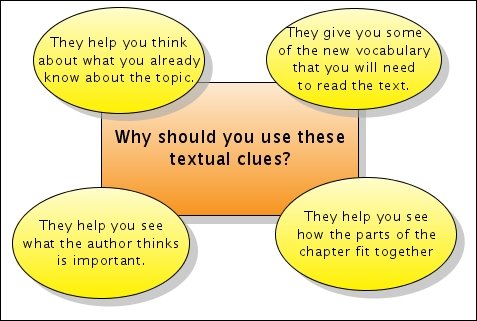
I know everyone else has already talked about Gliffy, but I wanted to add to the discussion. I have been using it to create graphics for lessons, and I am really impressed. The most recent one was on using clues in the textbook (pictures, tables, headings, etc.) to help you prepare for the actual reading. This graphic is one of the ones I included in the lesson. It isn't spectacular or anything, but I like it!

Check Gliffy out if you haven't. It is really cool!

Friday, June 16, 2006

Another benefit of blogging

I am taking my first online course this summer. I have designed online courses but never taken one before. (I know! Shame on me!) I am really enjoying the experience.

What I have noticed is that I am one of only 3 students in the course who is commenting on the posts of other students on the discussion board. The instructor continuously asks us to do that, but it isn't happening much.

Without a doubt it is easy for me to do because of blogging. Read what others write and comment on it -- What could be more natural?

Friday, June 09, 2006

Here's an odd one, for you...

Before posting it, I ran spell check on my last post. The only word it didn't like was "Blogger". Does that strike anyone else as odd?

A question about blog sites

A friend of mine is looking for a place to set up a blog. She is a Catholic religious (a nun to most of us), and she wants to set a blog up to talk about her ministry. She is looking for as family-friendly a site as possible. I showed her my blog, and she liked the looks of Blogger. She is worried, though, that it might be blocked in some schools. (Any site with the word "blog" in it was blocked by our server until last year, and we don't know that the Catholic schools around here would let it through even now.) Would any of you have any suggestions for free blog sites that might fit her needs? I would really appreciate any advice you might be able to give us.

Sunday, June 04, 2006

Electronic editing and other related topics

Miguel has a great post where he asks for input on the question of electronic editing vs. hard copy editing. I couldn't resist commenting there, and I decided to carry the conversation over here, as well.

Let me reface this by saying that I am 55 for two more months. I am not, by any stretch of the imagination, a member of the net generation. Heck, my children aren't even! What I am going to say may sound odd for someone my age, but that's the way it is.

Ten years ago I was in grad school. I hadn't written papers on anything but an old manual typewriter until that time. I always hand wrote everything, edited profusely and then typed it up and turned it in. That is how I started grad school. Before the first semester was out, I discovered that I wasn't going to be able to do it that way if I wanted to get everything done. I struggled until I learned to compose and edit electronically, bypassing paper until it was time to print and turn it in. Once I learned, though, it was just as easy to be ruthless with my writing on the computer as on a piece of paper. I have been extremely grateful for that training ever since then.

As an educator, I write papers, reports, proposal, memos, and many other types of documents. As a person, I blog and write letters and emails. I do all of those things exclusively on the computer. I have even pretty much stopped journaling on paper, moving the reflective parts of that to my blog and most of the rest to the recycle bin. Do I feel bad about this? No. Do I think I have compromised my standards somehow? No. Is my writing any worse because I am not editing ruthlessly? No; it is actually better because I am writing so much more.

But how can I work with students on their papers without hard copies? I almost always "mark up" their papers electronically. It is easier for me than hanging on to a zillion pieces of paper. If the students email the paper to me, I make comments and email the paper back. Last semester, I did not receive a single hard copy paper from my writing students. It was all turned in on Moodle.

What I like to do with my students is use one of the collaborative writing sites like Writely to actually sit down and have a conference with the student while we are each looking at the paper on our own computer screens. I can indicate where I think there is a problem and the student can attempt a change and I can give him instant feedback. Some of our best classes have been a group of us sitting at computers, with me going from paper to paper marking things up and them trying to fix the errors before I get back to them. It makes editing and revision much less boring.

I think teachers need to give serious thought to who their students are. It is the teachers who are hung up on hard copies, not the students. We have to give up trying to teach the students we were and, instead, teach the students we have.

Thursday, June 01, 2006

Fighting against technology in the classroom

A great post over at Assorted Stuff about the debate over technology in college classrooms. He says:
A growing number of schools are turning off wifi in classrooms or even banning laptops from classrooms in an attempt to persuade students to pay attention to whatever it is the professor is talking about.
and then goes on to quote Ken Fisher at Ars Technica, who wrote:

While calls to make education "more interesting" are commonly offered as the solution to what ails the classroom full of web surfers, such demagoguery falls flat on its face the minute one remembers that students' interests are as broad if not broader than the collegiate curriculum itself. ...

The bigger question is, if Joe Baccalaureate got through Econ 101 with an "A" while spending his time manicuring his rotisserie-style fantasy baseball team in lecture, what was the lecture for to begin with?


I think this is actually a much more revolutionary idea than it might appear on the surface. As a student, I sat through too many lectures that were merely an outline of the chapter than we were supposed to have read. In grad school I even had a professor who read the book to us! Why should students pay attention if there is nothing new offered in a lecture?

There is a need to rethink education at all levels. I don't think we can really force laptops and wifi out of our classrooms. I don't even think we should. But we need to see if there isn't a way we can use the technology to our advantage.

And we need to think about what we do as instructors. I need to ask myself, "Did my students learn something today that they couldn't have gotten anywhere else?" The answer won't always be yes,I'm sure, but it should be at least some of the time!

Wednesday, May 31, 2006

Blogging revisited

Miguel had a post that got me thinking about my blogging practice. As some of you who have been around for awhile, I used to be a daily blogger. Then it was every couple days. Then Hurricane Katrina knocked me out for a while. Since then I haven't been blogging as frequently. I have written about this before, and at the time, or at least after reading some comments on the post, I thought I was OK with it. But Miguel has me re-evaluating my take on it. He talks about how he blogs so regularly and says:
Blogging isn't something I do in addition to my day, it's something I do naturally as a part of my day.
and
I spend less time in front of the television, more time writing and reading.

I am trying to get back into more regular blogging. I know it is important to me, for me as a professional. I learn so much from the blogs I read, from the blog posts I write and from the comments I get.

I think that part of the problem is that I feel like I am back where I was a year and a half ago -- feeling like I have nothing to say. This is where Miguel has some ideas that I think will help me refocus. He talks about what he gets from his blog, saying:
In the past, I had to find a way to take notes, store emails, and ended up with lots of stuff everywhere. But now, I drop the links into my BlinkList (in lieu of Del.icio.us) and/or quickly jot down my impressions. This makes all the difference during my day. When I need to write something, I have a store of article ideas.
and
Well, my blogs enable me to jot down the ideas, factoids that would otherwise be lost. A visual learner, I HAVE to write it down to remember...and even then, it slips away.

This is a different way of looking at blogging than I have had lately. I think it will help. Let's see.

Tuesday, May 30, 2006

Taking the time to comment

This morning I read Ewan McIntosh's post about a student blog needing comments. This is something that I take very seriously, thanks to Anne Davis. I went to the blog and commented on a number of posts. It was fun and didn't take that long. I got a nice email from the teacher thanking me for commenting, too. You might want to check this blog out for yourself.

And then, in the last two days I have received comments from readers that have given me new insights into my own issues in the classroom. I would like to thank those of you who have recently or in the past commented on my blog. Each one of you has added something to my understanding of what it is I am trying to do as an educator.

Please take the time to comment on the blogs of others -- especially students. It matters more than we might think.

Thursday, May 25, 2006

Reflections on the semester's blogging

Bud's post reminded me that I need to post something about how the semester of blogging with my students went. I guess now is as good a time as any to begin working through that thorny issue.

The easiest blogging endeavor to comment on is that of my advanced writing students, who blogged at Debating the Death Penalty. This class of two students blogged their way through a WebQuest. I think this blogging went fairly well. It did not really encourage conversation, though, so it was not truly successful as a blogging activity. But since it achieved its purposes within the WebQuest and it helped to familiarize the students with blogging, I am content. With more students, the blog would have more energy, I think, so I will definitely do this again.

The other blog was that of my intermediate reading students. I made rather extensive use of the blog with this group. We did daily class logs, wrote summaries of what we were reading in class, and talked about the readings. On paper that is what we did. In the blog, it isn't quite that pretty. There was a lot of catch-up done at the last minute rather than timely posts. The quality of some of the writing is not what those students are capable of; I was unable to convince some of them of the need to post writing that people could read and understand. This is the blog that I wrote about earlier here and here and here. While it wasn't what I hoped for, the students all learned about blogging and wrote more than they probably would have otherwise in that class. It was, in that sense a success.

There are going to be big changes in my classes for the fall, but I have to design and teach a summer course before then, so I am not ready yet to talk about blogging in the fall. It will be a part of my courses; I am just not quite sure what form it will take. I'll be writing about this more as I begin to explore the possibilities.