Monday, June 26, 2006

Digital natives and immigrants

There is a great post over at Assorted Stuff about this divide between digital natives and digital immigrants. He feels that the idea of the divide is actually hurting the discussion about using technology in schools. He says:
For example, I'’ve noticed that too many people who are supposed to be instructional leaders seem to be trying to use the concept as a crutch, as an excuse for why they can'’t understand a specific piece of technology (or don'’t want to try).
He concludes with:
It'’s time for all educators to stop invoking the digital immigrant tag to write off their lack of understanding.
I think that he is right on the money with this. My son may have all music on his MP3 player while I still listen to CDs, but I understand about iPods and similar players. My grandchildren may pick up some new technology more easily than I do. That does not, however, mean that I cannot pick it up. I may choose not to use a particular technology in my own life, but I need to know about it if I am in the classroom because it will all be part of my students' lives.

Personally, I am committed to trying to stayinformed as I can. I don't want to be one of those people who always throws up his or her hands and says, "I'm too old for that!" It is actually fun to learn about the newest technology and its applications in the classroom.

Unless you really think you are too old to learn, why should age be an excuse for not at least becoming acquainted with what's going on out there?

Monday, June 19, 2006

Gliffy


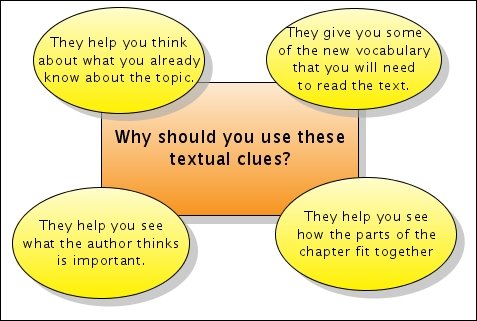
I know everyone else has already talked about Gliffy, but I wanted to add to the discussion. I have been using it to create graphics for lessons, and I am really impressed. The most recent one was on using clues in the textbook (pictures, tables, headings, etc.) to help you prepare for the actual reading. This graphic is one of the ones I included in the lesson. It isn't spectacular or anything, but I like it!

Check Gliffy out if you haven't. It is really cool!

Friday, June 16, 2006

Another benefit of blogging

I am taking my first online course this summer. I have designed online courses but never taken one before. (I know! Shame on me!) I am really enjoying the experience.

What I have noticed is that I am one of only 3 students in the course who is commenting on the posts of other students on the discussion board. The instructor continuously asks us to do that, but it isn't happening much.

Without a doubt it is easy for me to do because of blogging. Read what others write and comment on it -- What could be more natural?

Friday, June 09, 2006

Here's an odd one, for you...

Before posting it, I ran spell check on my last post. The only word it didn't like was "Blogger". Does that strike anyone else as odd?

A question about blog sites

A friend of mine is looking for a place to set up a blog. She is a Catholic religious (a nun to most of us), and she wants to set a blog up to talk about her ministry. She is looking for as family-friendly a site as possible. I showed her my blog, and she liked the looks of Blogger. She is worried, though, that it might be blocked in some schools. (Any site with the word "blog" in it was blocked by our server until last year, and we don't know that the Catholic schools around here would let it through even now.) Would any of you have any suggestions for free blog sites that might fit her needs? I would really appreciate any advice you might be able to give us.

Sunday, June 04, 2006

Electronic editing and other related topics

Miguel has a great post where he asks for input on the question of electronic editing vs. hard copy editing. I couldn't resist commenting there, and I decided to carry the conversation over here, as well.

Let me reface this by saying that I am 55 for two more months. I am not, by any stretch of the imagination, a member of the net generation. Heck, my children aren't even! What I am going to say may sound odd for someone my age, but that's the way it is.

Ten years ago I was in grad school. I hadn't written papers on anything but an old manual typewriter until that time. I always hand wrote everything, edited profusely and then typed it up and turned it in. That is how I started grad school. Before the first semester was out, I discovered that I wasn't going to be able to do it that way if I wanted to get everything done. I struggled until I learned to compose and edit electronically, bypassing paper until it was time to print and turn it in. Once I learned, though, it was just as easy to be ruthless with my writing on the computer as on a piece of paper. I have been extremely grateful for that training ever since then.

As an educator, I write papers, reports, proposal, memos, and many other types of documents. As a person, I blog and write letters and emails. I do all of those things exclusively on the computer. I have even pretty much stopped journaling on paper, moving the reflective parts of that to my blog and most of the rest to the recycle bin. Do I feel bad about this? No. Do I think I have compromised my standards somehow? No. Is my writing any worse because I am not editing ruthlessly? No; it is actually better because I am writing so much more.

But how can I work with students on their papers without hard copies? I almost always "mark up" their papers electronically. It is easier for me than hanging on to a zillion pieces of paper. If the students email the paper to me, I make comments and email the paper back. Last semester, I did not receive a single hard copy paper from my writing students. It was all turned in on Moodle.

What I like to do with my students is use one of the collaborative writing sites like Writely to actually sit down and have a conference with the student while we are each looking at the paper on our own computer screens. I can indicate where I think there is a problem and the student can attempt a change and I can give him instant feedback. Some of our best classes have been a group of us sitting at computers, with me going from paper to paper marking things up and them trying to fix the errors before I get back to them. It makes editing and revision much less boring.

I think teachers need to give serious thought to who their students are. It is the teachers who are hung up on hard copies, not the students. We have to give up trying to teach the students we were and, instead, teach the students we have.

Thursday, June 01, 2006

Fighting against technology in the classroom

A great post over at Assorted Stuff about the debate over technology in college classrooms. He says:
A growing number of schools are turning off wifi in classrooms or even banning laptops from classrooms in an attempt to persuade students to pay attention to whatever it is the professor is talking about.
and then goes on to quote Ken Fisher at Ars Technica, who wrote:

While calls to make education "more interesting" are commonly offered as the solution to what ails the classroom full of web surfers, such demagoguery falls flat on its face the minute one remembers that students' interests are as broad if not broader than the collegiate curriculum itself. ...

The bigger question is, if Joe Baccalaureate got through Econ 101 with an "A" while spending his time manicuring his rotisserie-style fantasy baseball team in lecture, what was the lecture for to begin with?


I think this is actually a much more revolutionary idea than it might appear on the surface. As a student, I sat through too many lectures that were merely an outline of the chapter than we were supposed to have read. In grad school I even had a professor who read the book to us! Why should students pay attention if there is nothing new offered in a lecture?

There is a need to rethink education at all levels. I don't think we can really force laptops and wifi out of our classrooms. I don't even think we should. But we need to see if there isn't a way we can use the technology to our advantage.

And we need to think about what we do as instructors. I need to ask myself, "Did my students learn something today that they couldn't have gotten anywhere else?" The answer won't always be yes,I'm sure, but it should be at least some of the time!

Wednesday, May 31, 2006

Blogging revisited

Miguel had a post that got me thinking about my blogging practice. As some of you who have been around for awhile, I used to be a daily blogger. Then it was every couple days. Then Hurricane Katrina knocked me out for a while. Since then I haven't been blogging as frequently. I have written about this before, and at the time, or at least after reading some comments on the post, I thought I was OK with it. But Miguel has me re-evaluating my take on it. He talks about how he blogs so regularly and says:
Blogging isn't something I do in addition to my day, it's something I do naturally as a part of my day.
and
I spend less time in front of the television, more time writing and reading.

I am trying to get back into more regular blogging. I know it is important to me, for me as a professional. I learn so much from the blogs I read, from the blog posts I write and from the comments I get.

I think that part of the problem is that I feel like I am back where I was a year and a half ago -- feeling like I have nothing to say. This is where Miguel has some ideas that I think will help me refocus. He talks about what he gets from his blog, saying:
In the past, I had to find a way to take notes, store emails, and ended up with lots of stuff everywhere. But now, I drop the links into my BlinkList (in lieu of Del.icio.us) and/or quickly jot down my impressions. This makes all the difference during my day. When I need to write something, I have a store of article ideas.
and
Well, my blogs enable me to jot down the ideas, factoids that would otherwise be lost. A visual learner, I HAVE to write it down to remember...and even then, it slips away.

This is a different way of looking at blogging than I have had lately. I think it will help. Let's see.

Tuesday, May 30, 2006

Taking the time to comment

This morning I read Ewan McIntosh's post about a student blog needing comments. This is something that I take very seriously, thanks to Anne Davis. I went to the blog and commented on a number of posts. It was fun and didn't take that long. I got a nice email from the teacher thanking me for commenting, too. You might want to check this blog out for yourself.

And then, in the last two days I have received comments from readers that have given me new insights into my own issues in the classroom. I would like to thank those of you who have recently or in the past commented on my blog. Each one of you has added something to my understanding of what it is I am trying to do as an educator.

Please take the time to comment on the blogs of others -- especially students. It matters more than we might think.

Thursday, May 25, 2006

Reflections on the semester's blogging

Bud's post reminded me that I need to post something about how the semester of blogging with my students went. I guess now is as good a time as any to begin working through that thorny issue.

The easiest blogging endeavor to comment on is that of my advanced writing students, who blogged at Debating the Death Penalty. This class of two students blogged their way through a WebQuest. I think this blogging went fairly well. It did not really encourage conversation, though, so it was not truly successful as a blogging activity. But since it achieved its purposes within the WebQuest and it helped to familiarize the students with blogging, I am content. With more students, the blog would have more energy, I think, so I will definitely do this again.

The other blog was that of my intermediate reading students. I made rather extensive use of the blog with this group. We did daily class logs, wrote summaries of what we were reading in class, and talked about the readings. On paper that is what we did. In the blog, it isn't quite that pretty. There was a lot of catch-up done at the last minute rather than timely posts. The quality of some of the writing is not what those students are capable of; I was unable to convince some of them of the need to post writing that people could read and understand. This is the blog that I wrote about earlier here and here and here. While it wasn't what I hoped for, the students all learned about blogging and wrote more than they probably would have otherwise in that class. It was, in that sense a success.

There are going to be big changes in my classes for the fall, but I have to design and teach a summer course before then, so I am not ready yet to talk about blogging in the fall. It will be a part of my courses; I am just not quite sure what form it will take. I'll be writing about this more as I begin to explore the possibilities.

Thursday, May 11, 2006

A difficult situation

I just had a conversation with a student in which he told me that if I place him where he needs to be placed next fall, he will leave the ESL program and, therefore, the school. This is one of the times that I am really glad that we have strict TOEFL score requirements for leaving the ESL program and for moving from level to level within the program. The matter is really out of my hands, and I could honestly tell him that. But it was still difficult.

ESL students often have unrealistic expectaions. They think that if they can speak enough English to get by, they can do university level work in English. Forget the fact that, in the case of my students, they will be studying Philosophy when they leave ESL and forget the fact that I, as a native English speaker, barely managed to get a C in the one college philosophy course I took. I would never want to study Philosophy in Spanish although I speak and read and write it quite well!

This is the worst case of this I have had in several years, so I shouldn't complain. But it was a draining experience talking with the student and then passing the information on to my Academic Dean. Just another reason that I sometimes find myself dreading the end of the year!

Wednesday, May 03, 2006

Listening to the radio

I just learned about a great website that I want to let you in on. Radio Lovers has lots of old-time (before my time even!) radio programs, at least some of which might be suitable for ESL/EFL students to listen to. They are available for free and, as nearly as anyone seems to know, without copyright issues. I want to explore these and see if I can't find a way to use some of them to spice up my classes a little. If you aren't familiar with the site and like old radio, check it out.

Saturday, April 29, 2006

Maybe it is all about me!

Yesterday we learned that the two students who had taken the TOEFL earleir in the month did not get the scores they needed to leave ESL and enter the regular program. It was the end of the day, and we were all pretty shocked by the news.

My first thoughts were about what I could have/should have/might have done differently so that they would have done better. TO eb honest, I guess that is still what my thoughts are.

I find it interesting since, a few short weeks ago, I felt that my students' performance wasn't a reflection on me. As I write this, though, I think this is slightly different. Maybe that is a rationalization, though!

I am coordinator of the ESL program. I designed it. I developed most of the courses intially. Until this new TOEFL, what we were doing worked. Our students seemed to advance through our program and get the TOEFL scores they needed to move on.

This new test tests different things in different ways. And my institution has set the scores pretty high. These are the first two of our students who have taken the iBT, and this is the second time they took the test. Their overall score was about the same on both attempts, but there was significant difference in some individual section scores.

So my question for myself has to be about what we can do differently to help students on this test. It may require some substantial changes to the program or they may just be minor tweaks. But I will be spending a lot of time this summer trying to answer that question!

It could, of course, be these students, both of whom have been in this country for years and have some pretty well-established bad habits. Unfortunately, it doesn't look like we will have anyone else ready to take the TOEFL for a while, so I can't test that hypothesis. So in the meantime, I have to assume that there is something we could be doing differently.

If any of you have experience with the TOEFL iBT, I would love to hear about it. How are your students doing? What scores has your institution set? If you do not want to post here, please email me.

Wednesday, April 26, 2006

Frequent blogging

The other day I was working on my faculty self-evaluation. Having decided that I would include my blogging in the evaluation under professional development, I decided to count my posts from the current academic year. I was really shocked to see how few posts I had. Some months there were only 4 or 5 posts. What happened to me, the daily blogger?

And then today I was reading Vickie A Davis's post where she highlights portions of a post by Marshall K in which he interviews Gina Trapani of Lifehacker (Wow, that's more than my usual quota of links!)

Vickie seleceted portions of the interview to post in her blog, and one of them really got me thinking.
Gina on building an audience

* On the editorial side, to build an audience, you need to post often. .. definitely update every day, if not twice a day. Your posts don't have to be long and thoughtful - though some should be - just summarize and point to a news item of the moment that's related to your nonprofit's area of interest. You want to establish a constant conversation about particular themes, and show that you're an authority on those themes, able to discuss them intelligently on an ongoing basis.


I am amazed that people are still reading my blog. Looking at how few posts I had during this academic year, and reading Gina's advice, it looks like no one should be bothering anymore. Now, granted, I am not the non-profit she is addressing, but I think that the advice is valuable. If I want this blog to be for more than just my entertainment, I have to make an effort to post more frequently again. Something for me to keep in mind. I may not achieve it, but I want to try.

Saturday, April 22, 2006

Blogging vs life

Christopher Sessums has an interesting post stemming from a comic strip. It is Zits strip that is, at least right now, available here. (Like most comics, it won't be available forever, so please forgive me if you look and it is gone!)

The comic has the son, Jeremy, interupting the father from telling the mother a story about his day. The son says,
I hate to see a person waste perfectly good blog material by describing his life experiences out loud.


Mr. Sessums has some interesting comments about the comic that are much more profound than anything I am going to say, so I advise you to read his post. I, on the other hand, have what is undoubtedly a much more mundane take on it.

What interests me about the comic is the idea of someone "wasting good blog material" by talking about it to a real live human being. This reminds me of something an acquaintace shared with me about her mother, who leaves family gatherings to journal about them. Do I want my written communication to replace face to face interaction with a human being? Or to take priority over it?

I love blogging. I love the conversation. But I wonder what I might be losing by blogging. Am I taking time from talking with my husband or with my friends to blog or to read blogs?

I guess I was thinking about this because of a post on a friend's blog in which he talks about his life at this point. He says, in part
Start with the little things like finding/making/carving out the time I need to write/think. Or take my daily walks - which I miss dreadfully but which are pushed back so I have more time to do -- what? Read blogs? Discard email spam? Patch computer programs? Fix stuff? Break stuff?

Heck, I haven't watched a movie in a month or more! Last thing I saw was an episode of Battlestar Galactica from season one.
I guess I am in a strange frame of mind today. But I think I am becoming clear about the place of blogging in my life. It is important. But it is not my life. I am not going to save the best parts of my life, the funniest, saddest, most interesting parts for my blog.

That being said, I have to get back to looking through my Bloglines account.

Monday, April 17, 2006

Blogging at my institution

Christopher Sessums has this post in which he gives initial results of his survey of edubloggers. Now, I had thought about answering the questionnaire but didn't. But - better late than never - I want to consider his questions here.

My institution does nothing to support or hinder my blogging either as a professional educator or, as of this year, with my students. We do not presently use any technology that would affect my blogging in any way. We began to use Moodle this year, but we have not set up its wiki capability yet. I don't think the institution has an opinion about blogs or wikis; I don't think that, as an institution, we are even really aware that they exist.

I plan to include my blog in my list of publications for my performance evaluation this year, but I have no fantasy that it will be viewed as professional writing or professional development of any kind. Since my institution does not offer tenure and evaluations don't really count for anything, I am in a position to do this to make a point -- even though few will "get it".

I feel very strongly that I connect to a community outside my institution through blogging. It is an informal community, but it is very real. This community, as I have often said, is the source of most of my professional conversation and, as a result, most of my professional learning. We don't have these kinds of conversations about teaching and learning at my institution.

But let me hasten to say that individuals in my institution have been extremely supportive of my blogging. Without their encouragement, I might have given up trying to blog with my students long before now. So I can't complain at all. The fact is that, by the very nature of my institution, we are not cutting edge in terms of technology. But we are moving forward, and there is a surprising level of acceptance.

I somehow think that my experience is not all that unusual. Maybe I am wrong. Please let me know if I am!

Wednesday, April 12, 2006

Keeping fresh

Kathy Sierra has a great post about pushing your skill set. Now, as usual, Kathy is talking primarily to tech people, but, as always, there is a lot that speaks to me as an educator. She starts out saying:
Are you doing anything to keep up your skills? Some of you don't have a choice--especially if you're doing client work where each new job "forces" you to learn something new. But for those of us who--like me--are mostly working on our own stuff, we can get... a little lazy. The techniques we've been using are like old friends. Doing it the way we've been doing it feels comfortable and less risky.

There has been discussion lately at my school about how students make use of what they call the "fund": knowledge passed from student to student, class to class about what particular professors emphasize, what they test on, etc. There was concern that maybe students aren't as "present" as they might be in class because of it. Now, obviously, this isn't anything new. Most of us have made use of that kind of information ourselves. But what amazes me is the reaction of many people to the situation. There is a feeling in some quarters that we should try to limit this in some way. No one is suggesting that maybe we should not teach the same class the same way with the same assignments and tests each and every year. Why? My guess is that it has something to do with what Kathy would probably call our "skill set". We are comfortable with the way we teach, with the material we present and the way we evaluate students. We shift the blame for the problem to them.

How can we push our skill set as educators? There are so many ways and they are so common and ordinary that I hesitate to even discuss them. But I think it is good for me to remind myself.

One way, of course, is just to learn more about our area of expertise. Even if you teach ancient philosophy, there must be something new you could learn about the subject matter.

If, however, you know absolutely everything there is to know about Plato, then I guess you have to think about learning something about teaching and learning. There is always something new to be learned in that area. Maybe you could learn about technology and how it might enhance what you do in the classroom.

Aside from our own learning, I think another important area to consider is how we evaluate students. If we always give the same assignments and the same type of test, we are foolish to think students aren't going to take advantage of that fact.

To K-12 teachers this probably sounds ridiculous; you cannot imagine any other way of doing things. But at the college level, it is fairly rare.

The key to pushing our skills, I think, is reflection. Unless we think about what we do in the classroom, we will never realize that maybe we need to do something differently.

So how do you keep yourself fresh? How do you vary what you do from year to year, semester to semester? I am interested in hearing and learning from you. I want to push my skills, and you can help me do it.

Update: Anne's post here seems to speak to this same issue. While she is talking about student reflection, there is a lot of food for thought for teachers as well. I am going to reread it and do some reflection of my own.

Tuesday, April 11, 2006

Computer problems

Just wanted to let you know that I am having computer problems and so may not get a chance to post much until I figure out what is going on with that. Hopefully it won't be too long, but you never know!

Sunday, April 09, 2006

Blogging and the examined life

Jo has had a couple of posts lately that I have found to be extremely interesting. First came this one, in which she passes on some thoughts from Inspiring Teachers that she got from their eZine. She quotes some ideas about reflection, including these:
What type of reflection works best? As usual, it varies from person to person, but there are a few things that everyone can do to make full use of those informal and formal reflections we make each day.

1.
Catch yourself thinking...
2. Don't be afraid to make changes immediately...
3. If you work in a teaming type situation where you and one or more teachers work together ...do some reflection together at the end of the day or at some point during the week...
4. Keep a journal...

I was an avid journaler before I became a blogger. Written reflection is critical to me. I still journal with my students, and it is usually of the writing-as-thinking variety. But now that I blog, the majority of my reflective writing is done here. Why? Because I have people to bounce my ideas off of. You. All of you who at one time or another have read and commented on my blog. You have made me examine my thoughts and ideas in new and different ways. I am grateful to you all.

Then Jo followed the other post up with this one, in which she refers to a post by Christopher Sessums. She ends that post by saying
... blogging is more than just professional learning - it is the opposite of the "unexamined life" which Socrates so disparaged.

What more could I possibly add? Check out Jo's blog, if you haven't yet.

Monday, April 03, 2006

Bud made the papers again!

Well, there I was reading a Washington Post article about teachers who blog, and all of a sudden I was reading part of a post that was very familiar to me. It was Bud! In the Washington Post!

While I was glad to see Bud getting the recognition, I was not happy to see the lead into it:
Read some and find out why more teachers than ever -- some estimates say up to half in this decade -- are leaving the profession feeling exhausted, disillusioned and underpaid.
It seemed to me that the implication was that Bud was leaving the profession or getting ready to or thinking about it.

The article is pretty simplistic, but it is nice to read about edubloggers in the Washington Post!