Saturday, June 30, 2007

The Future of Education

Derek had a post about an interactive Map of Future Forces Affecting Education. The map legend shows us that it looks at
Drivers ... These are six categories driving all trends, hotspots and dilemmas.
Impact areas ... These are five key areas of activity where major trends are revealed from different perspectives.
Hotspots ...These are key trends that we think have broad impact on education and often make good starting points for exploring the map.
Dilemmas ... These are issues that can't be solved with either/or thinking but require new strategies that go beyond simple problem solving.
Trends ... Trends make up the core of the map. They are major shifts, new phenomena and concepts, and driving forces that will shape the future context of public education.
The map looks at things that have not really been considered much in education up until now. To give you an idea, among the trends mentioned in the map is "increasing chronic illness". Clicking on the box tells us about rising youth obesity and the fact that 40% of public school students need mental health care. Looking at a real world application of this, they say that it is becoming harder to be healthy and we must look for ways for students' need for medical care not to adversely affect their ability to participate in school. It also says that that the health needs of children can help to create real change in education.

In the resource library they have a couple of presentations about the map. They give a pretty good overview of it. There are links to other resources connected to the various trends, etc. discussed in the map. There is a lot of valuable information here. And a lot to think about.

Wednesday, June 27, 2007

How do you define success?

I was looking at Mashable today and saw a post entitled 6 Key Ways to Measure Your Blog's Success. It is, as you might expect, a look at different rating systems like Technorati. And while I understand what they are talking about, it raised an important question in my mind: what does it mean for a blog to be successful?

I have yet to check Technorati to find out how my blog is doing -- largely because I would be surprised to see it there at all. None of my blogs have many readers. And that is OK with me because I don't think blogging is about numbers. To me, if there is one person who has gotten even one idea or one different perspective on just one topic, the blog has been successful. If one person reads something here that helps them see that they aren't the only one who thinks a certain way, it will be enough for me.

And actually, if no one reads this blog but me, I will still keep blogging because blogging is in large part about the writing and the thinking. I want to continue to do both within the confines of my blogs even if no one ever sees them because I will have learned something in the process. That in itself is success.

Sunday, June 17, 2007

I'm R2-D2.

OK. I haven't taken one of these tests in a long time. And since my son and I just bought our Star Wars stamps, this seemed appropriate.

Your results:
You are R2-D2


R2-D2
70%
Jabba the Hutt
64%
Yoda
62%
Qui-Gon Jinn
60%
Chewbacca
60%
Darth Maul
59%
Luke Skywalker
59%
Han Solo
59%
C-3PO
58%
Emperor Palpatine
57%
What you lack in height
and communication skills,
you make up for in industriousness,
technical know-how and being there
when others need you most.

(This list displays the top 10 results out of a possible 21 characters)

Click here to take the Star Wars Personality Test


Thanks to Darcy for the link!

Thursday, June 14, 2007

In answer to your question...

Lesley asked if there was a downside to using OpenOffice. So I will try to answer.

I would have to say that, yes, there are some sacrifices you make. For instance, there is no built-in reading level analyzer in OpenOffice (OO). There is an add-on you can get, but it is sometimes a little buggy. It is possible to track changes and everything, though, so that isn't a problem. You can add written comments to a paper, but as far as I know you cannot add audio comments.

Some things are not impossible in OO but seem a little more awkward to do. Page numbering is one of them. If you want the title page to not have a number or if you have pages with Roman numerals followed by regular numbering, it is a little complicated to do. I think, though, that if I did it more often, I would remember from one attempt to the next and not have to go to the forums looking for help.

That brings up one of the real advantages of OO and other open source tools is that there is a great community of users out there who have either already answered your question for someone else or will be willing to answer it for you if it hasn't come up yet. (I have never yet had a question for which I couldn't find the answer on the OO forum.)

The only other problem I have ever had is that sometimes when I open my OO .doc document in Word, the formatting is a little off. This can be frustrating. But I have had worse problems with using different versions of Word on computers in a computer lab.

For me, the advantages far outweigh the disadvantages, but not everyone would necessarily feel that way. But I go back to what I said last time: Download it and try it for two weeks and then decide.

Voice Thread 2

Darren had a link to Voice Thread, and I decided to give it a look. I initially wrote about it on my other blog but it wasn't possible to embed it there. So I came back over here to see what happened.

I think that this tool, which is free, could have potential for classroom use. It would be interesting to try.

Voice Thread

This is a test of Voice Thread and my blog's ability to embed it.

Look at the armadillo that came into my yard!

Wednesday, June 13, 2007

In praise of open source

Thanks to a post over at Kairosnews, I learned about an article in Linux Insider about the use of open source software. As a computer user running Ubuntu Linux, using Firefox, OpenOffice, Abiword, Audacity, and many other open source programs, there wasn't a lot that was new to me. But it was an interesting read.

The first part of the article discusses myths about open source. One of them that I have heard over and over is
Myth: Students need to learn the standard applications.
When you look at the job ads out there, this would seem to be true. I have really been looking at job ads lately, and it is amazing to me the number that want you to be able to use specific Microsoft programs -- even down to Outlook. There is seldom a discussion of what one needs to be able to do with these programs, merely the requirement that you know how to use them.

My son was recently enrolled in a college level IT class where he had to use Microsoft Office products. I tried to convince him that he could do it all in OpenOffice; after all, how could the professor tell what program he had used to prepare a document? He did most of it that way. Some assignments, though, required a discussion of the process of doing something in Word, for instance. He had to borrow a computer for those assignments.

The article addresses this myth, saying:
Schools have a responsibility to give students the skills they need to succeed. By the time high school students get to the job market, today's applications will be antiquated. Students need to know how to use word processors to communicate and spreadsheets to explore numbers and graphs. Their technical skills should transcend the particular idiosyncrasies of the applications
I wonder, though, if it isn't our fear as older adults that keeps students using "standard" applications. For many of us, this is all we know about computers. We are still, some of us, a little afraid of the machines. So we stick with what we know. Until we break out of the mold, we can't really help our students do it.

While we can't expect schools to all immediately switch to open source, do you think it would be possible to introduce it slowly? Could teachers get permission to download OpenOffice, for instance, and use it with their students?

This brings me to another myth:
Myth: Moving to F/OSS will require retraining and relearning.
The author's response was:
People are often reluctant to try new computer programs, though most users find only subtle differences between one program and another. In the course of giving conference presentations about F/OSS, two computer coordinators shared stories of upgrading some users' Microsoft Office suite with OpenOffice.org, leaving Microsoft Office icons as the means to start OpenOffice.org. In both cases, most users failed to notice that they were no longer using Microsoft Office.
So my challenge to you, if you are not using open source already, is to go out there and give it a try. Download a program and use it exclusively for two weeks. See if you don't like it.
It may take some getting used to, but it won't be any more difficult to adjust to than a Microsoft upgrade.

And if you aren't willing to do that, at least read the article.

Monday, June 11, 2007

The burden is on us

A History Teacher has an interesting post on plagiarism and how he has changed one of his assignments to avoid it. This is exactly the kind of thing that I think should be happening. Like the cheating with iPods I wrote about earlier, it seems to me that this is what we should be doing. Rather than expecting students to complete assignments that resemble the ones we were given as students with enthusiasm and integrity and then getting upset when they use their creativity (or lack of it, in the case of a lot of plagiarism) to get around it, we should be looking for ways to make our teaching and our assignments more relevant and more creative.

Dan mentioned a particular WebQuest assignment he has changed over the years to make it more "cheat-proof". That got me thinking about my own WebQuests. Granted, I will probably never again have an opportunity to use my Will the Real Thomas Merton Please Stand Up? assignment, but you never know. There was little in this assignment that did not lend itself to copying from the sources if my students had been so inclined. The other WebQuests I have done are about the same. But, I ask myself, what else could I have done? These assignments were for writing classes. They ask students to read, summarize, and synthesize information. If they wanted to copy from the sources, it was certainly possible.

This, for me, is the problem. I am the problem. I need to learn to think outside the box more. That is why I love reading blogs where teachers talk about what they are doing with their students. It's why I love Clarence Fisher and Darren Kuropatwa; they share their thinking and their work and allow me to learn from them. And there is so much I need to learn!

Sunday, June 10, 2007

A bit of persepctive

That's what I am hoping I have, at least.

I have returned from another unsuccessful job interview trip. At first I was devastated: how could they not want to even have a second interview with me for a job I was well qualified for? But that is what happened. We drove 1100+ miles for me to have a 20 minute interview.

Since returning, though, I have been thinking about what various readers have written about taking my time and trying to find what it is that I want to do. And I have really been thinking about the idea of NOT having a job. At least not having a 9-5/8-4 job I go to each day. The freedom of that is quite appealing. My concern with that before was that I know myself: I throw myself 110% into whatever I am doing. Could I do that with a variety of part-time jobs? A better question might be, do I want to give 110% to a job now? That obviously didn't work so well for me n my last job.

One thing that I know is that I do not want to define myself by my job anymore. I have more talent and ability than I give myself credit for. I am trying to develop a little faith in myself and a little more persepctive. And I am ready to get on with life.

Sunday, May 27, 2007

More to think about

I always read Borderland, but Teaching the Controversy gave me more to think about than usual. In addition to talking about teacher rights, he talks about teaching the curriculum. He discusses the idea of teaching the curriculum and teaching about the curriculum. He says:
The adopted curriculum might actually invite discussion and controversy if you study the curriculum document itself with students.
and
My thinking is that if we take a critical stance toward curriculum, we can still use it, and at the same time question it’s content, viewpoint, assumptions, and relevance. Along the way we can teach what it intends for students to learn, and we can also think about why. Learning that’s embedded in a real social context stands a far greater chance of making sense than simply reading through a catalog of goals and objectives.
I wrote the curriculum in my last job. And I never once shared it with my students. We never had that all-important discussion about why they were learning what they were learning. I never gave them the opportunity to question my assumptions or the curriculum's relevance. Not in any formal way, that is. We talked a lot about how we could improve the program, but we never did it in conjunction with the curriculum. I can only imagine what insight I might have gained if we had done that.

Many of my K-12 teacher friends struggle with a mandated curriculum that they feel doesn't allow them to do much real teaching. I wonder if Doug's ideas about sharing the curriculum with the students would help. Would it even be possible? As long as the curriculum is the enemy, it controls our lives. But if we make it our own, study it with our students as Doug suggests, maybe -- just maybe -- we can all learn something from it.

Freedom of Speech

Doug over at Borderland has a very thought-provoking post called Teaching the Controversy. In it he talks about the case of Deborah Mayer who lost her job because she told her elementary school teaching job because she told her students she honked for peace. A US court of appeals ruled that the school board was justified in firing her. According to an article in the San Francisco Chronicle,
As a federal appeals court in Chicago put it in January, a teacher's speech is "the commodity she sells to an employer in exchange for her salary."
My first reaction to reading that was amazement. Then it was disgust. Then I thought about the fact that I was bound, in my last job, not to publicly advocate anything that was in opposition to the teachings of the Catholic Church. And it hadn't bothered me. Of course, I don't publicly advocate much of anything. And I never felt that it limited my freedom to say what I wanted to about any topic in my classroom. My students always knew who I am and what I believe in. But in spite of my own feelings of freedom, I basically gave away my freedom of speech when I took the job.

What amazes me now as I think about it is the way I never really realized what was being asked of me. I just accepted it as something buried in the faculty handbook that didn't really apply all that much to me. And I am sure that Ms. Mayer never really thought about it either -- until she had lost her job.

But that is where the problem lies, I think. We need to be thinking more.

Thursday, May 24, 2007

Am I ready to teach in the 21st Century? Are you?

I love reading Barbara Ganley! She has a great post about the 21st century college teacher. It is actually the written version of a talk she gave.

The talk begins quite unconventionally:

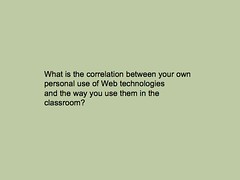
Because I am a writing teacher and because I believe you have to explore your own perspective on a topic a bit before hearing what someone else has to say, I'd like you to ponder this question for a few moments:

<span class=


When does a speaker ask the audience to think about the topic before beginning her/his speech and really mean it? It makes so much sense, though. That is something I want to remember to do when I make my next presentation.

The entire post/presentation is fascinating. She concludes by saying:
Yes, my father was right, if we have any hope at all that reading and writing matter, that schools matter, we do have to change our way of teaching -- what we teach even-- to focus on creativity and resilience, boldness and deep listening and observing, on conducting research and collaborating in fluid online conversations, to create bonds with community and bridges between the personal and the other. In other words, a liberal arts education should expose us to ideas and perspectives and give us training in collaboration, communication and creativity. And we have the tools, right here, to help us do just that.
As I contemplate moving into a different classroom in a different school this fall, I want to be better at doing what Barbara does and what she advocates doing. I know that, in spite of how I have changed my teaching over the last few years, I am still learning.

I am going to go back and read Barbara's post again and again, I think. There is a lot there.

Thursday, May 17, 2007

The end

Of my job, that is. I just got home from cleaning out my office. I am officially unemployed.

I have had some interviews. I withdrew myself from consideration for one when I realized it wasn't what I wanted to do. It became apparent in the first interview for another job that it wasn't going to be a good match. Then there was the cool second interview in San Francisco which also ended in no job offer for me.

But there are still applications out there, and I keep finding more. Something will happen -- soon, I hope!

Saturday, April 28, 2007

Just a question

Why is it that with all the furor about students using iPods to cheat on tests, no one seems to be considering the fact that maybe it is the tests that should be changed? Yes, even with a test that requires students to think and write a coherent answer, they could use an iPod to cheat, but it would be a lot harder I think. And they would still have to take the information on their crib sheets and turn it into an essay that answered the question.

Friday, April 27, 2007

Update on the job hunt

Before the update, I would like to thank everyone who has taken time to leave a comemnt on my earlier post about losing my job. I can't tell you how much they helped! Not only did they help me not to feel so alone, but they also contained very good advice.

I have applied for a number of jobs and have had several interviews. Some have been better than others, of course. I actually had a second interview for one job. So far I have not been told that I am not getting any of the jobs for which I have applied. I am trying to accept the fact that I may have to be patient.

I have thought a lot about what many people have said: that I need to figure out what I want to do. I am getting closer to understanding just what that is. It has been an interesting process. And then there is the very real possibility that I will be offered a job that I am not sure I want. I hope it doesn't come to that because I am not sure how I would handle it.

You can be sure that I will blog about it when I get a job and/or when I really figure out what it is I would like to do with my life. Intil then, thanks for the good thoughts!

Tuesday, April 24, 2007

Sharing Knowledge

Yesterday morning I checked my email and found a message from a young man I did not know. He had looked at my old online portfolio and wanted to know how I had done different things because he had an assignment for a class to create an online portfolio and wanted to do something like mine. I hoped he was talking about my new portfolio because I couldn't remember anything about my old one, but he really wanted to know about the old one. So I looked at it again and tried to remember how I had done things. Since I didn't know very much when I created that one two years ago, it wasn't hard to reconstruct what I had done.

So Gabriel and I spent the day yesterday exchanging emails, him asking questions and me trying to answer. In the end, he had a great looking portfolio ready for his instructor to look at this morning. I feel kind of like a proud mother!

This sharing of knowledge is what makes the world so different today. It isn't about protecting what I know but about seeing how what I know complements what you know and what we can construct with our combined knowledge. It is about how we can learn from each other -- whether we are teachers or students, parents or children, from this country or that. All those divisions are, in some ways at least, artificial.

So I thank Gabriel for asking me to share my knowledge. I learned as much as I taught.

Monday, April 16, 2007

Who am I?

I have been trying to figure out why I haven't been able to post very often lately, and I think I have finally figured it out. The answer is so simple that I can't believe it took me this long, but it did.

Having my job end has been a lot more traumatic for me than I realized at first. As my impending joblessness has gone on for almost 2 months now, I realize how lost I feel. I really feel like I am having to reinvent myself now because there aren't many jobs in my field in places I want to live. So if I am not an ESL teacher, who am I?

Six years ago before I started in my present job, it was much simpler. I still had a child at home, so I was not as much defined by my job as I have become. Also, it has only been in the last ten years that I have really felt like I have a profession. Until then, I just went from job to job and had a good time.

Part of me wants to go back to those more carefree days, but I have really enjoyed the last ten years and feel I still have a lot to contribute to my students. I would like to continue in the field of ESL, but I am not sure how many sacrifices I am willing to make - or ask my husband to make - to do it.

All I know for sure is that I wake up each day a little less sure of who I am. On so many levels, I don't like that! I'm not sure how I got to be so defined by my job. It leaves me wanting to get another job -- almost any job -- just to end the agony of not knowing. But then the cycle would just begin all over again. There is obviously more to this than finding another job. But right now, I would settle for that!

Wednesday, April 11, 2007

Food for thought

Thanks to Derek, I found the Making Teaching Public website. The site offers a look at some great teaching and great teachers from around the country.

What impresses me most about the site is just how public these teachers have made their teaching. I wonder at times just how much of my teaching I am really ready to make public. There are days when I am ready for the world to see what I do, but there are other days when I find I would rather keep it quiet.

As I have made my teaching more public by putting it on Moodle, by including wikis and webquests and blogs, I have fewer moments that I wouldn't want others to see. Not that everything goes perfectly, but I feel more like I am following a coherent plan. The secret, I think, is that I reflect much more on my uses of technology than I used to in my strictly textbook-based days. While my reasons for doing what I am doing may not be any more valid than they were before, the fact that I have thought more about them and expressed them more coherently seem to give my classes a more solid base. And it gives me more confidence in them, too.

Friday, March 30, 2007

A Question of Vision

I was trying to catch up on my reading this morning, and I came to a post on Derek's Blog about a new National Science Foundation publication entitled Cyberinfrastructure Vision for 21st Century Discovery, which is available for download here. It is a 64-page document, and I have just started reading it, but I was immediately struck by a statement from Dr. Arden L. Bement, Jr., Director of National Science Foundation. He said:
At the heart of the cyberinfrastructure vision is the development of a cultural community that supports peer-to-peer collaboration and new modes of education based upon broad and open access to leadership computing; data and information resources; online instruments and observatories; and visualization and collaboration services. Cyberinfrastructure enables distributed knowledge communities that collaborate and communicate across disciplines, distances and cultures. These research and education communities extend beyond traditional brick-and-mortar facilities, becoming virtual organizations that transcend geographic and institutional boundaries. This vision is new, exciting and bold.
It is, indeed.

Thursday, March 22, 2007

Miseducation

Thanks to Tim over at Assorted Stuff, I found a link to
Pete Reilly : Education's Hidden Messages. The post includes a list of some ways that our educational system is sending out the wrong message to students. Some of those ways include:

They are leaning that discovering and creating knowledge is beyond the ability of students and is really none of their business. ...

They are learning that the voice of authority is to be trusted and valued more than independent judgment. ...

They are learning that life’s answers lie outside themselves, in others. This lesson results, not only in students who believe others have their answers; but also that others are responsible for their problems. Students who have been taught this lesson take little accountability. ...

They are learning there is always a single unambiguous right answer to a question. If it can’t be measured, it’s not taught.

Unfortunately, I think that he is pretty close to being on the mark here. Even at the college level, too much is rote memorization -- especially in the first two years. I see my students agonize over upcoming tests, sure that they don't know the "right" answers. They never know what they are expected to know for the exam except that it is "Chapters 1-4 of the textbook".

The saddest part of what Reilly says, from my perspective, at least, is:
They are learning that risk taking is dangerous.

And, I guess, an awful lot of us past school age feel the same way.

Something has to change. And each of us, as an educator, has a responsibility to make an effort to improve the situation. We may not be able to eliminate the problems entirely, but we can improve the way we teach, what we teach and how we assess students in our own classrooms. It may not seem like much, but if enough of us do it...

(Crossposted from Moving Along)