Monday, November 27, 2006

Life begins at ...

I was reading over an old post at Creating Passionate Users and ran across this quote from Doc Searls:
"Nearly all of what I'm known for I've done since I was fifty."
Being past the 50 mark myself, I had to stop to think whether or not I could say the same. Not that I would even dream of putting myself in the same category as Doc, but I think that the same is pretty well true of me. In the last 6 years I have changed tremendously, grown tremendously. I have done things I would never have imagined I could / would do.

Another big milestone for me was 30. The change then was more personal and private but even more amazing. I literally became a different person. (I like to think a better one, too.)

Life is about change. It doesn't have to stop. It shouldn't stop. If we're lucky and work hard, the change can be positive growth rather than just getting older. It is exciting to think about what the future may hold. I wonder what I will learn once I am 60, 70 and beyond. Life doesn't begin at any particular age; it begins again each day. As Kathy said in her post,

It's never too late to be creative. It's never too late to make a difference. ... And remember the quote from the 90-something woman who, when asked about her regrets said, "If I'd known I was going to live this long, I'd have taken up the violin at 60. I'd have been playing for almost 40 years by now..."

Monday, November 20, 2006

My students and technology

My friend Angie commented on my last post, and I started to comment on her comment. Then I decided that I was writing enough to warrant a whole post.

My students usually have very limited understanding of technology. Part of what I do is teach them how to create PowerPoints, how to use library databases, etc. I take this part of my job very seriously. We are using Moodle this year to do hybrid or blended classes because it is important that they learn how to do more with computers than email and games. I feel good about the fact that my students leave me with the computer skills and experience they need to succeed in their other classes.

I try to give my students options; tomorrow one student will be showing us a movie he made. But another is creating his first PowerPoint. I encourage them to stretch themselves and their technological expertise. And they never cease to amaze me.

Angie talks about consulting the students about how to achieve the goals of the class . That is something I don't do enough of. I would like to try to change that this next semester. My students, even though they are adults, are not used to making any decisions or having any real input into their education. This sometimes makes it difficult for them to think about it deeply. And that is my biggest frustration. I have been doing a lot of "writing as thinking" with them this semester in an attempt to get them to go a little deeper, but it has not been tremendously successful. That does not mean, though, that I should give up on it.

I would like to get them excited about writing, and I think technology could help us do that. But not if the basic assignments are not exciting. I would like to experiment with having them produce alternatives to the research paper, for instance. Maybe a wiki. Maybe a blog. Maybe webtexts that are written for the Internet rather than print. The important thing is that the students learn how to do the research, how to think critically about the information they find, and how to write about it. The format doesn't matter. Could I offer a variety of options? Could each student do something different? Why not? I am the only thing keeping us from doing it that way. Am I up to it? Why not?

Sunday, November 19, 2006

No, I guess we still don't get it.

Clarence has once again pointed out just how little we get it. He says, in part:
First of all, we still don't get it. We are still trying to appropriate the literacy practices of youth culture, and co-opt them for our own means. We use hip - hop to teach grammar. We use blogs to nitpick the ultra fine points of novels and to teach grammar. We don't honour the literacy practices of the people in our classrooms for what they are. To many teachers, they are not legitimate on their own. ...

Second, we still crave control. We are willing to give kids the experience of blogging, if they are responding to a list of prompts. We are willing to use video if the videos are a series of X number of shots, each lasting no longer then X number of seconds. ... Are we still doing old things in new ways? 5 paragraph essays in video form?

The more I think about my use of new technologies, the less sure I am of myself. I don't want to do the same old thing in new ways. We need to truly revolutionize education to meet the needs of our students today. But how? It is hard for me to think so far out of the box. But at the same time, as an older experienced teacher, I can be creative, take chances.

At any rate, I am thinking again about the next semester. What can I do differently? Not for entertainment value but for learning. Not old things in new guises.

If you haven't read his post, check it out.

Thursday, November 16, 2006

Blogging next semester

I've been thinking about next semester and have decided to try blogging again with my writing students. I plan to have students write their early drafts of papers and post them to Moodle and then, when they are satisfied with them, they will post them to the blog.

When I do that, I know that I have to build an audience for them. Since I will probably only have two students in that class, we almost can't be our own audience! If there is no audience and there are no comments, there is no reason to blog. I guess I will make an appeal to anyone who happens by here to go there (wherever 'there" is) to read my students' blogs.

So be prepared to be invited and encouraged to comment on my students' posts next semester. Don't say you weren't warned!

Monday, November 06, 2006

Adult Literacy Education Wiki

For more than I year now I have known about the Adult Literacy Education Wiki, but it was only recently as I have gotten to be more comfortable with wikis that I have taken a real interest in it.

The wiki is a great resource for anyone in the US or probably Canada (and maybe other countries as well) who is interested in literacy at almost any level. The wiki is divided into a number of topic areas including Basic Literacy, Classroom Practices that Work, Professional Development, Technology and Young Adult Literacy.

I am currently the topic leader for the ESOL area. I am not sure yet exactly what that means, but I guess I will find out.

I would encourage any of you who are interested in literacy in any way to check this wiki out. It is filled with good information.

Saturday, November 04, 2006

Another presentation fraught with problems

Yesterday I made a presentation at the LaTESOL conference in Baton Rouge, LA. I wanted to show the participants some of the cool tools that are available online. It started off well. I had set up a wiki with links to a lot of things and wanted us to look at the ones they were most interested in. I could access the wiki fine, but we were unable to access all the sites. It wasn't that they were blocked -- just a connection problem of some sort.

We talked about many of the tools and I was able to answer many of their questions even though I wasn't able to actually show them the tools. So on the whole, I was pretty content. I felt a little stupid every time a new site didn't open, but they seemed to take it in stride.

It is so much nicer to do an internet based presentation than a typical "slide show". But when they don't work, it is a problem. I had most of the presentation in an OpenOffice Presentation, but I didn't want to do it that way. I couldn't have individualized the program nearly as well. But I have to think about how I an do this in the future. I don't want another technology problem in a presentation on technology -- It's hard to win converts that way!

Wednesday, November 01, 2006

JotSpot

A year or so ago Bud got me interested in JotSpot, a wiki site. I started a wiki there but never really did much with it. Now I probably never will. Google has just acquired it to add to its "stable". As they did with Writely, you cannot get a new account there until the migration to Google's system is complete. You can, however, sign up to be put on the waiting list here. If you want to, that is.

Sunday, October 22, 2006

Google Docs

Joanna asked what I thought of Google Docs. I have to admit that I really find it hard to make myself use it. I have always disliked the big Microsoft conglomeration of tools that can be accessed through one simple log-in. I feel the same way about Google. I am not convinced that I wan't them controlling my online life any more than I wanted Microsoft to do it.

I am planning to really look seriously at ZohoWriter and ThinkFree and any other smaller word processors I can find before I try to sue one with my students. It seems like there are new tools out there on an almost daily basis.

The only problem is that all these little companies are hoping to go the route of Writely and be gobbled up by some big company someday. I don't think you can pick one of these and expect to use them forever. I guess you might have to be happy if you can make it through to the end of the semester before you have to look for a replacement.

My presentation

Well, I went to the conference prepared for anything -- and it was a good idea. We couldn't find a computer lab that we could actually use, so I was either going to borrow a LCD projector or just going to have people gather around my laptop to see the presentation that is below. It ended up, though, that we found a lab we could use and we worked from this outline. We didn't get through all of it, of course, but I tried to address their main concerns, which seemed to center around publishing student work. All in all, it went well.

Friday, October 20, 2006

I can't keep up!

Things are changing so fast that I officially can't keep up! I was preparing a presentation for tomorrow on technology and writing for the Southeastern Louisiana Writing Project. We weren't sure if I would be doing it in a computer lab where the participants would sit at their own computers and follow along as I did things or if I would need to do it as a PowerPoint presentation, so I prepared a PowerPoint to use in case I don't have Internet access.

I got it all done -- and then Writely officially became Google Docs. So I updated the URLs and made other little changes.

Then I heard that I will probably have Internet access, so I had to figure out the best way to cover all the same ground as I had in my PowerPoint (actually, OpenOffice Impress) presentation. I decided the easiest way would probably to put it all in a wiki. So I finally sat down and more or less figured out how to work with wikis. So now I have the links and everything there.

Then I read some posts to a literacy list I subscribe to, and I heard about Quick Topic, which allows you to add a discussion board to a website. So I set one up for the presentation to allow participants to introduce themselves and express their questions and interests. So if, as it now looks, each participant will have access to a computer, they will be able to post their introduction and tell what they hope to get from the presentation. After reading these, I will be able to shape the direction of the presentation. Of course, if no one expresses interest in or curiosity about anything, I can always go back to the prepared information.

I am almost afraid to check my Bloglines account again until after tomorrow morning because I don't want to get any more great ideas for my presentation! But I can't believe how much I have learned this week as I seriously began to put all this together!

Wednesday, October 11, 2006

A good question

Nathan posted a great comment on my previous post and asked a good question:
If we take away the "because it's convenient for the teacher" criterion, what else -- besides blog-or-not -- goes up for negotiation?


Any thoughts?

Monday, October 09, 2006

Rethinking blogging... again

Joanna posted a response to my reflection on the semester that got me thinking. She said that she had decided not to blog with her students now since there are so many other options out there, like Writely.

I wonder if there isn't some wisdom in that. Blogging is, at its best anyway, a personal endeavor as the result of a personal commitment. Who was is it a year or so ago who said that blogging shouldn't be something students had to do but rather something they did because they wanted to? Is that true?

I wonder what it would be like, if it would be possible to offer students a variety of outlets for their work and let them choose the one(s) they wanted to use. If a student wanted to blog, he could. If he only wanted to post inside Moodle, he could. If another wanted to use Writely, she could. Would there be any value in that? I know it would be a nightmare to try to evaluate student work if it were spread over too many different repositories - unless you have as few students as I do. But would there be value in allowing students that kind of freedom?

Sunday, October 08, 2006

Write to My Blog

Joanna blogged about Write to My Blog and, being totally captivated by neat little applications and websites, I had to try it.

A while back I had written that I didn't think I would have a reason to type something up outside my blog and then post it to the blog, but I think it might have value.  Let's see how this works! 


Reflection on the semester so far

This semester has been the most interesting one I have had for awhile. The main reason for this, I think, is the fact that we decided to make the ESL courses "blended", with have the class hours done face to face and the other half done online using Moodle. I have been really fascinated by the use of technology in my classes for several years now, so this has been an exciting step.

So far it seems to be working quite well. My students seem to think they are being overworked, but they always had that opinion. What I see is that they are becoming more responsible for themselves and their learning. The transition hasn't always been easy, but for the most part it hasn't been bad.

Even before decided to put the classes online, I had decided not to use blogs with my students this semester. I wrote about that here. I am very glad that I made that decision. I have used Moodle's forum feature extensively with both my reading and my writing students. (That's like BlackBoard's Discussion Board, for those who don't know.) It has taken time, but they are learning to reply to each others' posts. They are having discussions that, increasingly, don't involve me. I am so excited by this fact that I am thinking about incorporating blogs again in the spring. Part of it, I know, is that my doing the work of putting the classes on Moodle, I have spent more time thinking on creating good assignments. That was part of the problem before; my assignments weren't quite right considering the responses I was hoping to get. Now my assignments lend themselves more to discussion. I have not made any definite decisions about this yet, of course, but I see it as a distinct possibility. I just need to think more about what I think they would gain by blogging rather than using a forum. I want to be clear about the reasons for switching before I do it.

So all in all, I am pretty happy with how things are going. The students also seem to be happy. We are off to a good start.

Tuesday, October 03, 2006

Work space

Kathy Sierra's post on the importance of the space in which we work got me thinking. I looked around my office and was appalled! But then I said, "Well, you don't spend that much time here, so maybe it's OK." And then I thought about where I usually work when I am at home. Not much better. Between the two places, I spend a considerable amount of time each day working in less than inspiring surroundings.

Then I thought back to where we lived before Katrina, a dilapidated old house with a great front porch overlooking the river. Now there was a place to work! It was so peaceful and inspiring and yet so full of life at the same time that I think I actually could get more done in less time.

The question, of course, is what am I going to do about this. Kathy went out and bought an old Airstream and converted it into her office. It looks beautiful. But that doesn't seem to be in the cards for me. I think I really need to do something, though.

Wednesday, September 27, 2006

Did you read it? Where?

Within the last week or so, I am sure I read a post or an article somewhere that talked about academic writing (in English) being a foreign language. Did anyone else see it? It's one of those things I should have furled or something, but didn't. And now I need it for a paper I am writing! I would appreciate any help you might be able to give me.

Sunday, September 24, 2006

Writing Project weekend

I have just returned from a 2-day retreat with our local Writing Project site, the Southeastern Louisiana Writing Project. It was great to get away, spend time with my writing friends and make plans for the coming year.

I urge any US teacher who might read this post to check out their local Writing Project site. If you don't know where the nearest site is, check out the National Writing Project website for a list of sites by state. You don't have to be an English teacher, and it doesn't matter if you teach Kindergarten of graduate students; the Writing Project has something for you!

Tuesday, September 19, 2006

Beginners welcome

Vicky has an interesting post about the power of a newbie. She refers to a comment she had received from a beginner who had felt insecure about blogging her beginner experiences. Vicky quotes from one of her previous posts:
When you are a newbie, you have something that tech-experts do not have: the perspective of a new user.

Another important point in this discussion, I think, is that we are all beginners at something. So people who have been blogging for awhile may be scuffling to learn about wikis and people who have been podcasting "forever" are looking at some next thing. Once you get involved in this technology and what it can do for you and your classes, you have begun a never-ending process of exploration and learning.

So, like Vicky, I encourage anyone who is even remotely interested to join the discussion. We are all learning from each other, no matter how new or how experienced. That's the beauty of it: not that there are a large number of experts to lead us through the process but that we are all in it together, helping each other out when we can.

Friday, September 15, 2006

Student Responsibility

As you are probably aware, I am doing my ESL courses as blended courses this semester. It is going better than it might but it hasn't been real easy getting the students to this point.

One thing that I have really noticed is that this is forcing students to be more responsible. It has allowed me to see how I held their hands for way too long, I think. Now, they complete the assignments or they don't. It isn't like they can come to class and fake it; the forum post is there or it isn't. Also, they have to manage their time themselves. I am not doling the work out in bite-sized chunks -- although it is in bite-sized chunks on Moodle. But there are lots of different chunks out there at the same time. It is helping them learn to prioritize and juggle a number of tasks at once.

I hadn't really thought about this aspect of blended courses, but I am real happy about it.

Wednesday, September 13, 2006

Provocative Teaching

A friend of mine likes to say that teachers must be seductive. She means it in only the best way, of course: that we must draw our students into the subject matter, into learning itself. So when I read Kathy Sierra today, I understood where she was coming from when she said we should Be Provocative.

Kathy, as always, has some great ideas. If we want to be provocative, she thinks we should:
* Be Visual
* Be Different--Break Patterns and Expectations
* Change Things Regularly
* Inspire Curiosity
* Pose a Challenge
* Be Fun
There is nothing really shocking or new on the list. It actually just sounds like good teaching practice, to me. But how often do I really do these things? Something to think about...

Thursday, September 07, 2006

A neat little tool

Thanks to Darren, I discovered Folder Marker. It's a nifty little program that lets you change to color of your folder or your folder icons. Now, that may not seem like much, but I have a tendency to have a million folders in My Documents, and this really makes it easier for me to see at a glance what I have where.

If you are a pack rat like me, you might want to check it out!

Monday, September 04, 2006

Up and running wirelessly in Ubuntu

After installing Ubuntu a few weeks ago, I have had nothing but problems computer-wise. They had nothing to do with Ubuntu - just bad luck on my part. I ended up having to reformat my hard drive and reinstall Windows (where the problem occurred) a week ago. I decided to reinstall Ubuntu today, and I made up my mind I would get the wireless running. Well, to make a long story short, I am working in Ubuntu and am connected wirelessly. Hurrah! I was beginning to doubt it would ever happen, but it did. So now I can explore Ubuntu more and, hopefully, get to the point where I can get rid of Windows entirely. But for now, I am happy just to be where I am!

Off and running again

Well, the semester is off and running again, and I hope my blogging is, too.

I am teaching two courses half online and half face-to-face this semester. They account for a total of 16 hours of instruction each week. It has been interesting to see the students adapt to this new structure. They think they are working twice as hard because of all the things to do on Moodle, but they don't see that they have 4 hours of "class time" to do it in! Guess that means they are normal students, doesn't it? There is going to be a period of adjustment, but I think this is going to end up being a better way to do the courses. We'll see, though.

In addition to teaching three courses and sitting in on a math class my advanced students are taking, I am also taking a course this semester. It is on language and literacy. We just read a book by Mike Rose called Lives on the Boundary. Rose believes strongly in the importance of the individual, of the human being in the educational process. It's an excellent book and an easy read.

Well, I think anyone who reads this for their patience. I hope to be around a lot more regularly again!

Thursday, August 31, 2006

Alive and well and swamped

In case anyone noticed, I have been a little more absent than usual lately. Call it the last minute push to get ready for the semester, teaching courses I have taught before but with materials that were brand new to me. Then imagine, the day before classes are to start, discovering you have to scrap most of that and start all over again. That has been the story of the last couple weeks of my life.

I will be back once I am more than a couple days ahead of the students!

Sunday, August 20, 2006

Writely is open again!

Thanks to a post over at Assorted Stuff, I learned that Writely is open for new users again. A quick glance at it didn't show up anything that looked different from its pre-Google days. If you haven't' checked Writely out before, now would be a good time!

Tuesday, August 15, 2006

Fall, 2006

At the present time I am not planning to have my students blog this semester. I have mixed feelings about it. I think it would be cool to have a successful blogging project with my students, but I don't know that I have really had one.

I know a lot of it is that I never quite got the blogging assignments right. For this semester I think I have decent assignments. One is even "stolen" from The Year of the Hangman Book Blog. So why not do it as a blog myself? I don't know.

This semester I am focusing on using Moodle more. What would have been blog assignments will be discussion forum assignments. I hope that once my students become more accustomed to writing online on a regular basis and get the idea of commenting on each others' posts to the forum, they will have an easier transition to blogging. I also want them to take their online writing more seriously and do a better job of it.

Am I giving up too soon? Making excuses? Making a mistake?

I think that I am in some ways. And I am disappointed in myself.

Thursday, August 10, 2006

Switching to Ubuntu

My husband has used Linux for a number of years and Ubuntu for the last couple. I have always said I wanted to do the same, but there was always some restriction on that -- like, I'll do it when the warranty on my computer runs out or when the semester is over or something. Well, I finally took the leap last weekend. Actually, I am dual booting Ubuntu and Windows until I get my wireless card working in Ubuntu. (I have one of those cards that doesn't like to work with Linux, but many people have gotten it to work, so it is just a question of time before I get it going.)

So what? Why post about this at all? This morning I was reading Miguel Guhlin's blog this morning and came across this post. Richard Stallman's comment, which forms the basis of Miguel's post, really made me think.

I have a long way to go before I reach that level of putting my money where my mouth is, I'm afraid. These little reminders are good for me!

Saturday, August 05, 2006

Remember Pearlington

The Blogathon for Pearlington is underway. Check it out!

As we approach the one year anniversary of Katrina, there is much to be grateful for but also much to regret. Our 87 year old friend finally was able to move back into her condo 10 days ago. In the 11 months since the storm, she had lived in Illinois, Florida, 2 apartments in the New Orleans area, and her daughter's house here in St. Tammany Parish after she gave notice at her last apartment and then found she couldn't move into the condo yet -- despite promises to the contrary. She is one of the lucky ones; she has financial resources. Others are in much less pleasant circumstances.

If you haven't yet, please donate money or time or effort for Pearlington or anywhere else along the Gulf Coast that was hit by and still struggles with the effects of Katrina.

Monday, July 24, 2006

Test your personality

Haven't done any online tests lately, so when I ran across a couple on Miguel's site, I had to try them. I won't tell you which President I am most like because I refuse to believe it. But my personality came up just as I expected it to: I am a Nurturer.

You Are An ISFJ

The Nurturer

You have a strong need to belong, and you very loyal.
A good listener, you excell at helping others in practical ways.
In your spare time, you enjoy engaging your senses through art, cooking, and music.
You find it easy to be devoted to one person, who you do special things for.

You would make a good interior designer, chef, or child psychologist.


Actually, this is interesting because last semester I sat in on a Psychology class with my students, and we did official personality tests and I came up with the same type.

Sunday, July 23, 2006

Advice on wikis, please!

I am going to be using a wiki this fall. It is a new venture for me. It seems like it will be easy, but I am afraid I might be kidding myself. I want to use the wiki well, and I am not sure what I need to know or remember. Any suggestions?

In one class students will be reading a variety of material about the Civil War. I want them to post it to the wiki so the information that each gathers from individual reading will be available to all. In this case I guess I am using it for notetaking. Students will be able to get information from it to complete their final project: a "magazine" about the Civil War from the point of view of either the North or the South, depending on which group they are in. While students will be put in North/South groups about halfway through the unit, they will do initial readings about both the North and the South.

In another class, a writing class, we are going to be looking at famous documents and speeches from US history and then writing about them. I am basing this course loosely on an MIT Open Courseware course called American Classics. I am not exactly sure how I will be using the wiki with this class, but I imagine it will be for notetaking, too.

I am excited about this, but I am not sure how it is going to work. My initial blogging attempts were less than successful, and I hope to do better with wikis. I appreciate any help anyone might be able and willing to offer.

Monday, July 17, 2006

Blogathon for Katrina Relief

Joanna and Sharon have a great idea for raising money to help Pearlington, Mississippi recover from Katrina. They are going to be blogging for 24 hours. And you are invited to help by blogging or donating money or both. Check it out here.

Friday, July 14, 2006

Choosing literature for ESL

I am in the process of getting ready to write the final paper for a course I am taking this summer on young adult literature. I think I want to write it on evaluating YA lit for use in college level ESL classes. So I am sending out a plea to those of you who teach ESL at the college level or teach adults in other settings: Have you ever used YA lit with your adult students? How did you decide which books to use? How were the books received by the students? What books would you recommend and why?

If you don't teach adults but are an adult yourself, have you ever read YA literature? Why? What was your reaction to the book?

If you teach young adults, which books that you use with your students do you think would be appropriate to use with adults?

I really appreciate any insights you might be able to give me. Thanks!

Tuesday, July 11, 2006

The best of times and the worst of times

Seeing your name in Stephen Downes' Old Daily definitely qualifies as a high point! I was shocked, to say the least, to see that he was referencing a post by Jo McLeay about my Creative Commons license post.

But why, oh why did I forget to run spell check on the post that was going to be seen by lots more people than usual?

Saturday, July 08, 2006

Writing with online word processors

I am writing an article on online word processors for my state LaTESOL newsletter, and I decided to check out some of the features of Writely that I hadn't played with before. Posting to my blog is one of them. I am anxious to see how this works.

If you have ever used Writely, ThinkFree, Zoho Writer or Writeboard, I would love to hear your experiences.

I am not really sure why I would want to write my posts in an online word processor and then post them to my blog. I am not sure I see the reason for the extra step. But for people who work and rework their posts (like Miguel) I guess I can see it.

These tools are more important to me as another way for writers to collaborate. If we're not connecting with them, what's the point?

Just a thought

Reading Stephen Downes Half an Hour, I came across this line that I just wanted to share.
You cannot incite a revolution. You have to be the revolution. There is no other way.

What else is there to say?

Friday, July 07, 2006

Copyright issues

Jim over at Blogging Pedagogy has a post about selling course materials and comments on the fact that he has added a Creative Commons license to the blog. This is something I have been thinking about a lot lately. I can't believe that something I have written is copyrighted just because I have written it. But it is. I can't find the sites where I originally read about it, but Wikipedia has an article about it here.

Anyway, I decided to add a Creative Commons license to this blog. Not because I am worried about anyone stealing anything they find here but rather because I want to make a statement. I believe in Creative Commons licensing. I believe in sharing our thoughts and ideas and our words.

As far as I am concerned, this license doesn't change anything here on the blog. But I want to make it official.

Grammar with a little help from some Legos

Dennis Jerz has created a presentation unlike any I have ever thought of doing: active and passive sentences with a little help from a Lego man! Check it out here on his blog!

Monday, July 03, 2006

A cool resource

I have just been playing around with a cool resource at ESL Activities.com - a BINGO card maker for vocabulary words. You can insert up to 25 words and their definitions and it will create the cards and allow you to print the BINGO cards, print flashcards with the words and their meanings, and print a call card for the instructor to use. You can print from 1-99 BINGO cards, and the words are scrambled so they are not in the same position on all the cards.

Now, most of you may not be interested in this, but it will be really great for those of you who could use it. Check it out! They also have a crossword generator, but I haven't checked it out yet.

Monday, June 26, 2006

Digital natives and immigrants

There is a great post over at Assorted Stuff about this divide between digital natives and digital immigrants. He feels that the idea of the divide is actually hurting the discussion about using technology in schools. He says:
For example, I'’ve noticed that too many people who are supposed to be instructional leaders seem to be trying to use the concept as a crutch, as an excuse for why they can'’t understand a specific piece of technology (or don'’t want to try).
He concludes with:
It'’s time for all educators to stop invoking the digital immigrant tag to write off their lack of understanding.
I think that he is right on the money with this. My son may have all music on his MP3 player while I still listen to CDs, but I understand about iPods and similar players. My grandchildren may pick up some new technology more easily than I do. That does not, however, mean that I cannot pick it up. I may choose not to use a particular technology in my own life, but I need to know about it if I am in the classroom because it will all be part of my students' lives.

Personally, I am committed to trying to stayinformed as I can. I don't want to be one of those people who always throws up his or her hands and says, "I'm too old for that!" It is actually fun to learn about the newest technology and its applications in the classroom.

Unless you really think you are too old to learn, why should age be an excuse for not at least becoming acquainted with what's going on out there?

Monday, June 19, 2006

Gliffy


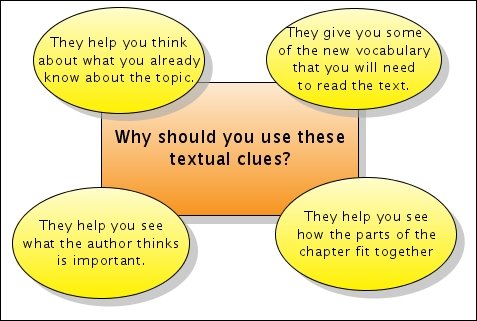
I know everyone else has already talked about Gliffy, but I wanted to add to the discussion. I have been using it to create graphics for lessons, and I am really impressed. The most recent one was on using clues in the textbook (pictures, tables, headings, etc.) to help you prepare for the actual reading. This graphic is one of the ones I included in the lesson. It isn't spectacular or anything, but I like it!

Check Gliffy out if you haven't. It is really cool!

Friday, June 16, 2006

Another benefit of blogging

I am taking my first online course this summer. I have designed online courses but never taken one before. (I know! Shame on me!) I am really enjoying the experience.

What I have noticed is that I am one of only 3 students in the course who is commenting on the posts of other students on the discussion board. The instructor continuously asks us to do that, but it isn't happening much.

Without a doubt it is easy for me to do because of blogging. Read what others write and comment on it -- What could be more natural?

Friday, June 09, 2006

Here's an odd one, for you...

Before posting it, I ran spell check on my last post. The only word it didn't like was "Blogger". Does that strike anyone else as odd?

A question about blog sites

A friend of mine is looking for a place to set up a blog. She is a Catholic religious (a nun to most of us), and she wants to set a blog up to talk about her ministry. She is looking for as family-friendly a site as possible. I showed her my blog, and she liked the looks of Blogger. She is worried, though, that it might be blocked in some schools. (Any site with the word "blog" in it was blocked by our server until last year, and we don't know that the Catholic schools around here would let it through even now.) Would any of you have any suggestions for free blog sites that might fit her needs? I would really appreciate any advice you might be able to give us.

Sunday, June 04, 2006

Electronic editing and other related topics

Miguel has a great post where he asks for input on the question of electronic editing vs. hard copy editing. I couldn't resist commenting there, and I decided to carry the conversation over here, as well.

Let me reface this by saying that I am 55 for two more months. I am not, by any stretch of the imagination, a member of the net generation. Heck, my children aren't even! What I am going to say may sound odd for someone my age, but that's the way it is.

Ten years ago I was in grad school. I hadn't written papers on anything but an old manual typewriter until that time. I always hand wrote everything, edited profusely and then typed it up and turned it in. That is how I started grad school. Before the first semester was out, I discovered that I wasn't going to be able to do it that way if I wanted to get everything done. I struggled until I learned to compose and edit electronically, bypassing paper until it was time to print and turn it in. Once I learned, though, it was just as easy to be ruthless with my writing on the computer as on a piece of paper. I have been extremely grateful for that training ever since then.

As an educator, I write papers, reports, proposal, memos, and many other types of documents. As a person, I blog and write letters and emails. I do all of those things exclusively on the computer. I have even pretty much stopped journaling on paper, moving the reflective parts of that to my blog and most of the rest to the recycle bin. Do I feel bad about this? No. Do I think I have compromised my standards somehow? No. Is my writing any worse because I am not editing ruthlessly? No; it is actually better because I am writing so much more.

But how can I work with students on their papers without hard copies? I almost always "mark up" their papers electronically. It is easier for me than hanging on to a zillion pieces of paper. If the students email the paper to me, I make comments and email the paper back. Last semester, I did not receive a single hard copy paper from my writing students. It was all turned in on Moodle.

What I like to do with my students is use one of the collaborative writing sites like Writely to actually sit down and have a conference with the student while we are each looking at the paper on our own computer screens. I can indicate where I think there is a problem and the student can attempt a change and I can give him instant feedback. Some of our best classes have been a group of us sitting at computers, with me going from paper to paper marking things up and them trying to fix the errors before I get back to them. It makes editing and revision much less boring.

I think teachers need to give serious thought to who their students are. It is the teachers who are hung up on hard copies, not the students. We have to give up trying to teach the students we were and, instead, teach the students we have.

Thursday, June 01, 2006

Fighting against technology in the classroom

A great post over at Assorted Stuff about the debate over technology in college classrooms. He says:
A growing number of schools are turning off wifi in classrooms or even banning laptops from classrooms in an attempt to persuade students to pay attention to whatever it is the professor is talking about.
and then goes on to quote Ken Fisher at Ars Technica, who wrote:

While calls to make education "more interesting" are commonly offered as the solution to what ails the classroom full of web surfers, such demagoguery falls flat on its face the minute one remembers that students' interests are as broad if not broader than the collegiate curriculum itself. ...

The bigger question is, if Joe Baccalaureate got through Econ 101 with an "A" while spending his time manicuring his rotisserie-style fantasy baseball team in lecture, what was the lecture for to begin with?


I think this is actually a much more revolutionary idea than it might appear on the surface. As a student, I sat through too many lectures that were merely an outline of the chapter than we were supposed to have read. In grad school I even had a professor who read the book to us! Why should students pay attention if there is nothing new offered in a lecture?

There is a need to rethink education at all levels. I don't think we can really force laptops and wifi out of our classrooms. I don't even think we should. But we need to see if there isn't a way we can use the technology to our advantage.

And we need to think about what we do as instructors. I need to ask myself, "Did my students learn something today that they couldn't have gotten anywhere else?" The answer won't always be yes,I'm sure, but it should be at least some of the time!

Wednesday, May 31, 2006

Blogging revisited

Miguel had a post that got me thinking about my blogging practice. As some of you who have been around for awhile, I used to be a daily blogger. Then it was every couple days. Then Hurricane Katrina knocked me out for a while. Since then I haven't been blogging as frequently. I have written about this before, and at the time, or at least after reading some comments on the post, I thought I was OK with it. But Miguel has me re-evaluating my take on it. He talks about how he blogs so regularly and says:
Blogging isn't something I do in addition to my day, it's something I do naturally as a part of my day.
and
I spend less time in front of the television, more time writing and reading.

I am trying to get back into more regular blogging. I know it is important to me, for me as a professional. I learn so much from the blogs I read, from the blog posts I write and from the comments I get.

I think that part of the problem is that I feel like I am back where I was a year and a half ago -- feeling like I have nothing to say. This is where Miguel has some ideas that I think will help me refocus. He talks about what he gets from his blog, saying:
In the past, I had to find a way to take notes, store emails, and ended up with lots of stuff everywhere. But now, I drop the links into my BlinkList (in lieu of Del.icio.us) and/or quickly jot down my impressions. This makes all the difference during my day. When I need to write something, I have a store of article ideas.
and
Well, my blogs enable me to jot down the ideas, factoids that would otherwise be lost. A visual learner, I HAVE to write it down to remember...and even then, it slips away.

This is a different way of looking at blogging than I have had lately. I think it will help. Let's see.

Tuesday, May 30, 2006

Taking the time to comment

This morning I read Ewan McIntosh's post about a student blog needing comments. This is something that I take very seriously, thanks to Anne Davis. I went to the blog and commented on a number of posts. It was fun and didn't take that long. I got a nice email from the teacher thanking me for commenting, too. You might want to check this blog out for yourself.

And then, in the last two days I have received comments from readers that have given me new insights into my own issues in the classroom. I would like to thank those of you who have recently or in the past commented on my blog. Each one of you has added something to my understanding of what it is I am trying to do as an educator.

Please take the time to comment on the blogs of others -- especially students. It matters more than we might think.

Thursday, May 25, 2006

Reflections on the semester's blogging

Bud's post reminded me that I need to post something about how the semester of blogging with my students went. I guess now is as good a time as any to begin working through that thorny issue.

The easiest blogging endeavor to comment on is that of my advanced writing students, who blogged at Debating the Death Penalty. This class of two students blogged their way through a WebQuest. I think this blogging went fairly well. It did not really encourage conversation, though, so it was not truly successful as a blogging activity. But since it achieved its purposes within the WebQuest and it helped to familiarize the students with blogging, I am content. With more students, the blog would have more energy, I think, so I will definitely do this again.

The other blog was that of my intermediate reading students. I made rather extensive use of the blog with this group. We did daily class logs, wrote summaries of what we were reading in class, and talked about the readings. On paper that is what we did. In the blog, it isn't quite that pretty. There was a lot of catch-up done at the last minute rather than timely posts. The quality of some of the writing is not what those students are capable of; I was unable to convince some of them of the need to post writing that people could read and understand. This is the blog that I wrote about earlier here and here and here. While it wasn't what I hoped for, the students all learned about blogging and wrote more than they probably would have otherwise in that class. It was, in that sense a success.

There are going to be big changes in my classes for the fall, but I have to design and teach a summer course before then, so I am not ready yet to talk about blogging in the fall. It will be a part of my courses; I am just not quite sure what form it will take. I'll be writing about this more as I begin to explore the possibilities.

Thursday, May 11, 2006

A difficult situation

I just had a conversation with a student in which he told me that if I place him where he needs to be placed next fall, he will leave the ESL program and, therefore, the school. This is one of the times that I am really glad that we have strict TOEFL score requirements for leaving the ESL program and for moving from level to level within the program. The matter is really out of my hands, and I could honestly tell him that. But it was still difficult.

ESL students often have unrealistic expectaions. They think that if they can speak enough English to get by, they can do university level work in English. Forget the fact that, in the case of my students, they will be studying Philosophy when they leave ESL and forget the fact that I, as a native English speaker, barely managed to get a C in the one college philosophy course I took. I would never want to study Philosophy in Spanish although I speak and read and write it quite well!

This is the worst case of this I have had in several years, so I shouldn't complain. But it was a draining experience talking with the student and then passing the information on to my Academic Dean. Just another reason that I sometimes find myself dreading the end of the year!

Wednesday, May 03, 2006

Listening to the radio

I just learned about a great website that I want to let you in on. Radio Lovers has lots of old-time (before my time even!) radio programs, at least some of which might be suitable for ESL/EFL students to listen to. They are available for free and, as nearly as anyone seems to know, without copyright issues. I want to explore these and see if I can't find a way to use some of them to spice up my classes a little. If you aren't familiar with the site and like old radio, check it out.

Saturday, April 29, 2006

Maybe it is all about me!

Yesterday we learned that the two students who had taken the TOEFL earleir in the month did not get the scores they needed to leave ESL and enter the regular program. It was the end of the day, and we were all pretty shocked by the news.

My first thoughts were about what I could have/should have/might have done differently so that they would have done better. TO eb honest, I guess that is still what my thoughts are.

I find it interesting since, a few short weeks ago, I felt that my students' performance wasn't a reflection on me. As I write this, though, I think this is slightly different. Maybe that is a rationalization, though!

I am coordinator of the ESL program. I designed it. I developed most of the courses intially. Until this new TOEFL, what we were doing worked. Our students seemed to advance through our program and get the TOEFL scores they needed to move on.

This new test tests different things in different ways. And my institution has set the scores pretty high. These are the first two of our students who have taken the iBT, and this is the second time they took the test. Their overall score was about the same on both attempts, but there was significant difference in some individual section scores.

So my question for myself has to be about what we can do differently to help students on this test. It may require some substantial changes to the program or they may just be minor tweaks. But I will be spending a lot of time this summer trying to answer that question!

It could, of course, be these students, both of whom have been in this country for years and have some pretty well-established bad habits. Unfortunately, it doesn't look like we will have anyone else ready to take the TOEFL for a while, so I can't test that hypothesis. So in the meantime, I have to assume that there is something we could be doing differently.

If any of you have experience with the TOEFL iBT, I would love to hear about it. How are your students doing? What scores has your institution set? If you do not want to post here, please email me.

Wednesday, April 26, 2006

Frequent blogging

The other day I was working on my faculty self-evaluation. Having decided that I would include my blogging in the evaluation under professional development, I decided to count my posts from the current academic year. I was really shocked to see how few posts I had. Some months there were only 4 or 5 posts. What happened to me, the daily blogger?

And then today I was reading Vickie A Davis's post where she highlights portions of a post by Marshall K in which he interviews Gina Trapani of Lifehacker (Wow, that's more than my usual quota of links!)

Vickie seleceted portions of the interview to post in her blog, and one of them really got me thinking.
Gina on building an audience

* On the editorial side, to build an audience, you need to post often. .. definitely update every day, if not twice a day. Your posts don't have to be long and thoughtful - though some should be - just summarize and point to a news item of the moment that's related to your nonprofit's area of interest. You want to establish a constant conversation about particular themes, and show that you're an authority on those themes, able to discuss them intelligently on an ongoing basis.


I am amazed that people are still reading my blog. Looking at how few posts I had during this academic year, and reading Gina's advice, it looks like no one should be bothering anymore. Now, granted, I am not the non-profit she is addressing, but I think that the advice is valuable. If I want this blog to be for more than just my entertainment, I have to make an effort to post more frequently again. Something for me to keep in mind. I may not achieve it, but I want to try.

Saturday, April 22, 2006

Blogging vs life

Christopher Sessums has an interesting post stemming from a comic strip. It is Zits strip that is, at least right now, available here. (Like most comics, it won't be available forever, so please forgive me if you look and it is gone!)

The comic has the son, Jeremy, interupting the father from telling the mother a story about his day. The son says,
I hate to see a person waste perfectly good blog material by describing his life experiences out loud.


Mr. Sessums has some interesting comments about the comic that are much more profound than anything I am going to say, so I advise you to read his post. I, on the other hand, have what is undoubtedly a much more mundane take on it.

What interests me about the comic is the idea of someone "wasting good blog material" by talking about it to a real live human being. This reminds me of something an acquaintace shared with me about her mother, who leaves family gatherings to journal about them. Do I want my written communication to replace face to face interaction with a human being? Or to take priority over it?

I love blogging. I love the conversation. But I wonder what I might be losing by blogging. Am I taking time from talking with my husband or with my friends to blog or to read blogs?

I guess I was thinking about this because of a post on a friend's blog in which he talks about his life at this point. He says, in part
Start with the little things like finding/making/carving out the time I need to write/think. Or take my daily walks - which I miss dreadfully but which are pushed back so I have more time to do -- what? Read blogs? Discard email spam? Patch computer programs? Fix stuff? Break stuff?

Heck, I haven't watched a movie in a month or more! Last thing I saw was an episode of Battlestar Galactica from season one.
I guess I am in a strange frame of mind today. But I think I am becoming clear about the place of blogging in my life. It is important. But it is not my life. I am not going to save the best parts of my life, the funniest, saddest, most interesting parts for my blog.

That being said, I have to get back to looking through my Bloglines account.

Monday, April 17, 2006

Blogging at my institution

Christopher Sessums has this post in which he gives initial results of his survey of edubloggers. Now, I had thought about answering the questionnaire but didn't. But - better late than never - I want to consider his questions here.

My institution does nothing to support or hinder my blogging either as a professional educator or, as of this year, with my students. We do not presently use any technology that would affect my blogging in any way. We began to use Moodle this year, but we have not set up its wiki capability yet. I don't think the institution has an opinion about blogs or wikis; I don't think that, as an institution, we are even really aware that they exist.

I plan to include my blog in my list of publications for my performance evaluation this year, but I have no fantasy that it will be viewed as professional writing or professional development of any kind. Since my institution does not offer tenure and evaluations don't really count for anything, I am in a position to do this to make a point -- even though few will "get it".

I feel very strongly that I connect to a community outside my institution through blogging. It is an informal community, but it is very real. This community, as I have often said, is the source of most of my professional conversation and, as a result, most of my professional learning. We don't have these kinds of conversations about teaching and learning at my institution.

But let me hasten to say that individuals in my institution have been extremely supportive of my blogging. Without their encouragement, I might have given up trying to blog with my students long before now. So I can't complain at all. The fact is that, by the very nature of my institution, we are not cutting edge in terms of technology. But we are moving forward, and there is a surprising level of acceptance.

I somehow think that my experience is not all that unusual. Maybe I am wrong. Please let me know if I am!

Wednesday, April 12, 2006

Keeping fresh

Kathy Sierra has a great post about pushing your skill set. Now, as usual, Kathy is talking primarily to tech people, but, as always, there is a lot that speaks to me as an educator. She starts out saying:
Are you doing anything to keep up your skills? Some of you don't have a choice--especially if you're doing client work where each new job "forces" you to learn something new. But for those of us who--like me--are mostly working on our own stuff, we can get... a little lazy. The techniques we've been using are like old friends. Doing it the way we've been doing it feels comfortable and less risky.

There has been discussion lately at my school about how students make use of what they call the "fund": knowledge passed from student to student, class to class about what particular professors emphasize, what they test on, etc. There was concern that maybe students aren't as "present" as they might be in class because of it. Now, obviously, this isn't anything new. Most of us have made use of that kind of information ourselves. But what amazes me is the reaction of many people to the situation. There is a feeling in some quarters that we should try to limit this in some way. No one is suggesting that maybe we should not teach the same class the same way with the same assignments and tests each and every year. Why? My guess is that it has something to do with what Kathy would probably call our "skill set". We are comfortable with the way we teach, with the material we present and the way we evaluate students. We shift the blame for the problem to them.

How can we push our skill set as educators? There are so many ways and they are so common and ordinary that I hesitate to even discuss them. But I think it is good for me to remind myself.

One way, of course, is just to learn more about our area of expertise. Even if you teach ancient philosophy, there must be something new you could learn about the subject matter.

If, however, you know absolutely everything there is to know about Plato, then I guess you have to think about learning something about teaching and learning. There is always something new to be learned in that area. Maybe you could learn about technology and how it might enhance what you do in the classroom.

Aside from our own learning, I think another important area to consider is how we evaluate students. If we always give the same assignments and the same type of test, we are foolish to think students aren't going to take advantage of that fact.

To K-12 teachers this probably sounds ridiculous; you cannot imagine any other way of doing things. But at the college level, it is fairly rare.

The key to pushing our skills, I think, is reflection. Unless we think about what we do in the classroom, we will never realize that maybe we need to do something differently.

So how do you keep yourself fresh? How do you vary what you do from year to year, semester to semester? I am interested in hearing and learning from you. I want to push my skills, and you can help me do it.

Update: Anne's post here seems to speak to this same issue. While she is talking about student reflection, there is a lot of food for thought for teachers as well. I am going to reread it and do some reflection of my own.

Tuesday, April 11, 2006

Computer problems

Just wanted to let you know that I am having computer problems and so may not get a chance to post much until I figure out what is going on with that. Hopefully it won't be too long, but you never know!

Sunday, April 09, 2006

Blogging and the examined life

Jo has had a couple of posts lately that I have found to be extremely interesting. First came this one, in which she passes on some thoughts from Inspiring Teachers that she got from their eZine. She quotes some ideas about reflection, including these:
What type of reflection works best? As usual, it varies from person to person, but there are a few things that everyone can do to make full use of those informal and formal reflections we make each day.

1.
Catch yourself thinking...
2. Don't be afraid to make changes immediately...
3. If you work in a teaming type situation where you and one or more teachers work together ...do some reflection together at the end of the day or at some point during the week...
4. Keep a journal...

I was an avid journaler before I became a blogger. Written reflection is critical to me. I still journal with my students, and it is usually of the writing-as-thinking variety. But now that I blog, the majority of my reflective writing is done here. Why? Because I have people to bounce my ideas off of. You. All of you who at one time or another have read and commented on my blog. You have made me examine my thoughts and ideas in new and different ways. I am grateful to you all.

Then Jo followed the other post up with this one, in which she refers to a post by Christopher Sessums. She ends that post by saying
... blogging is more than just professional learning - it is the opposite of the "unexamined life" which Socrates so disparaged.

What more could I possibly add? Check out Jo's blog, if you haven't yet.

Monday, April 03, 2006

Bud made the papers again!

Well, there I was reading a Washington Post article about teachers who blog, and all of a sudden I was reading part of a post that was very familiar to me. It was Bud! In the Washington Post!

While I was glad to see Bud getting the recognition, I was not happy to see the lead into it:
Read some and find out why more teachers than ever -- some estimates say up to half in this decade -- are leaving the profession feeling exhausted, disillusioned and underpaid.
It seemed to me that the implication was that Bud was leaving the profession or getting ready to or thinking about it.

The article is pretty simplistic, but it is nice to read about edubloggers in the Washington Post!

Saturday, April 01, 2006

Characteristics of good blogs

Thanks to Darren for the link to Bill MacKenty's post in which he lists the eSchool news criteria for what makes a good blog. It includes:

1. Personality

2. Usefulness

3. Writing style

4. Usability and design

5. Frequency

6. Relevancy

7. Interactivity

8. Fulfillment of purpose

9. Appropriateness

10. Would you revisit
Bill's post includes the description of each of these. You really should check it out.

As I look at my own blog, I see that I need to do some work in some of these areas. Maybe all of them. Something to think about...

Friday, March 31, 2006

A question for the experts...

On a discussion forum my husband participates in, a computer science student asked a question about computer science degree programs. My husband asked if I knew the answer, and I said that I didn't, but that I would be happy to ask you, the experts:

Do you know of a college or university that teaches computer science and at least recognizes the open source movement? Is there a degree program out there that you know of that at least exposes students to Linux and mySQL and other open source software?

Thanks for whatever you are able to tell me.

Saturday, March 25, 2006

Why aren't we all blogging?

Will's post here about people who choose not to blog or who don't get why we do this, and I had to think back to the presentation I made last week. The woman who was in charge of the technology portion of the program said that she sees blogging as a "lifestyle choice" that she isn't willing to make. She is young, a PhD, and very technologically inclined. But I think she is right: blogging is a choice that affects all the other aspects of your life to one degree or another. For me, it is all positive, but I can see that some might not see it that way.

I wonder if she and others don't see blogging as too "passive", to disconnected from life. This woman, for instance, compared blogging to her mother's need to leave a family gathering to journal about it. Of course, we who blog know that it is anything but passive or disconnected. But I wonder sometimes if people don't see it as the adult equivalent of playing video games -- an artificial online world that keeps us from socializing and being socialized in real time. I don;t know if it is possible to convince people of the value of blogging if they can't see it right off the bat.

Will also made me think about my classes. One of my students has really taken to posting on the class blog much more than his classmates have. This man is the one I would have least expected to embrace blogging, but he really has. I have seen him become much more involved in what we are doing on the blog than he ever seemed to be before we were blogging. He may not always do his other homework, but he always makes his blog posts. He checks the blog frequently to see if there are new questions for him to answer. I am not sure why this is so. But it has really made me think about how to capitalize on this interest that he has.

Will asks the question of whether or not "getting blogging" is really a generational thing. I don't think it is. But I am not sure what the difference is between those of us who blog and those who don't. Part of it may be that some of us are more comfortable with writing than others -- although I have seen my very non-writer husband take to blogging.

So why is it that some of us blog and others don't? Any thoughts?

And I guess I should also ask another question: Do we really want everyone to blog? Is that a desired outcome? If so, why?

Sunday, March 19, 2006

Thanks!

Thanks to all of you who commented below to tell me why you blog with your students. The presentation went pretty well, although I could easily have used much more time than I had. A couple actually signed up for blogs during the session. In addition to some time in a technology session, I participated in a poster session where I got to talk to many teachers who weren't able to attend the technology session.

The teachers there were most impressed, I think, by your quick responses to my post. They could see the potential of blogs from that one post. I cannot thank you all enough!

Thursday, March 16, 2006

And yet another favor to ask...

I am making final preparations to talk about blogging to a group of teachers on Saturday. One thing I want to talk about is why we blog with our classes. I would greatly appreciate it if you could leave me a brief comment here telling me why you blog with your students. I would like to share your thoughts with the teachers who come to the meeting. Thanks so much!

Tuesday, March 14, 2006

Blogging as academic writing

Jo's post about constructing an academic life really got me thinking. She says,

But there is still a disconnect between what bloggers think we'’re doing and what many academics think of blogging. The lack of editors and other gatekeepers, and the lack of peer review make the knowledge production of edubloggers suspect in some people'’s eyes. This is strange I think since blogging is not so much a technique, as a space where people write and are read, where readers can comment and writers review. Isn't this what learning is about?

I think she makes an excellent point, and I wonder what we can do to change perceptions of blogs in the academic world.

It seems to me that we would have a hard time getting blogs accepted as the equivalent of an article published in a peer reviewed journal. But couldn't it be considered the equivalent of a conference presentation, which often go through a less rigorous review process? The audience provides a type of peer review. To demonstrate audience, we could show the numbers of comments, for instance. In my case, at a very small college where things are pretty loose in some ways and we have no tenure anyway, this just might work.

Has anyone tried to get their blog accepted by their institution as academic writing? If so, I would love to hear about it.

And then there is always the other question: Is this even worrying about? I am certainly not blogging for anyone but myself. Every time I blog, every time I read another edublog, I learn something valuable. Maybe I should just be happy with that.

Wednesday, March 08, 2006

Is it all about me?

Somehow or other I keep coming back to this question.

As a parent, it was hard to accept that my children's failures and mistakes and even their successes as they got older were their own, rather than a reflection on me and my parenting. I remember when my oldest daughter decided at 17 to take the GED. I had a hard time accepting that it was OK -- good even. I was worried about how it would look, what people would think about me. Fortunatley, I have pretty much gotten past that.

But now I find myself asking the same question as a teacher. Are the mistakes of my students a reflection on me and my teaching?

In a comment to my previous post, Bronwyn indicated that they are. In the not-too-distant past I would have agreed with her; I felt that if my students appeared to be less than perfect, it somehow meant I was not a "good" teacher. But now I have to say that I don't agree.

My students, all learning English as adults, make mistakes in their writing. Those mistakes are probably a reflection of what they have not mastered yet, but they may not reflect at all what they have been taught and taught well. Learning a second language is not a matter of being exposed to the "right" way to do things in English and then being able to do it consistently. This is especially true when it comes to writing. I expect them to make mistakes. And I don't think it means I am a bad teacher when they do.

I would really appreciate hearing what others of you think about this. Obviously, despite what I have written here, I am still somewhat conflicted.

Tuesday, March 07, 2006

Editing student work

Mousing Around - MGuhlin.net - Editing Student Writing

Miguel writes about a discussion list posting about editing student writing that is going to be put online or, really, published in any way. I had seen the list postings when they were made but somehow or other I didn't connect to them until I read about them in Miguel's blog. (Does that say something about where and how I get my real professional development? I think so.)

The gist of the question was whether or not teachers should "tweak" student writing so it is "perfect" prior to publication. On the list several arguments were presented for both sides. Miguel talks about how he had decided to not do that kind of correcting when he was in the classroom full time.

The post got me to thinking about my own situation.

A couple weeks ago I decided that my students weren't careful enough in their blog posts, so I had them look at other class blogs to see the quality of the student writing. (This was the basis of my "failed experiment.") They didn't see what I had wanted them to see there.

But I am wondering why I want their posts to be perfect. Is it for them or for me? I think I know the answer and I don't like it too much. I have to think about this some more.

Tuesday, February 28, 2006

Thanks for the suggestions

Well, if I weren't already convinced, the quick responses I got to my earlier post about ideas for sharing blogging with some teachers would have made me a believer in the support we can get and give in the blogging community! I'd like to thank Bud and Stephen for their ideas.

I was interested that they suggested Darren's work -- not because I didn't know about Darren or because I didn't think his work was any good but because I had shown my students one of Darren's class blog just the other day. I was trying to get them to better understand what I wanted in the daily log/scribe posts. We have been doing them all semester, but I thought it would be good for them to see other examples. So I guess Darren will definitely be included in my presentation!

To try to answer Bud's questions, this presentation is part of what is normally the Southeastern Louisiana Writing Project's "October Showcase". Because of Katrina, it wasn't held in October but was postponed to March. The audience is largely teachers or ed students who want to get some ideas about including writing in their classes. We have some writing activities throughout the morning but before that there is a time when attendees wander around looking at posters and talking to the teacher-consultants who have prepared them. Last year (actually a year and a half ago - before I was blogging) I talked about using Nicenet as a place to publish students' writing and as a way of communicating with students and, if desired, with their parents. The teachers I spoke to said it sounded good, but they had no real access to computers in their classrooms -- or there was one computer for the whole class to use. I doubt that things will have improved in this past year. My guess is that most teachers who come this time will not be at all familiar with blogging, so I will be introducing the concept and then talking to them about the possibilities for blogging with their students.

That being said, there are a few teachers who will be there who are already using some blogging in their classes, so I will be further exploring the possibilities with them. I think they can benefit from Darren's work, too.

So once again, thanks for the suggestions, Bud and Stephen. I want teachers who aren't yet blogging to see the kinds of support available to them through the blogging community, so I will be talking about you on the 18th, too!

Helping student bloggers get it

In a comment to a recent post below, Susan made some great points. She said
As I introduced the blogs, I told them that part of the power of having their own blog was that it could help them share the things they care about, and it could connect them with other people with the same interests.
What a perfect explanation!

She goes on to say that she is thinking of having her students set up Bloglines accounts so they can begin to read and comment on blogs of interest to them. It seems so obvious to me now that it will be easier for my students to get commenting if they are reading blogs -- especially blogs they are really interested in! So that goes on my agenda for things to do this semester.

Any suggestions?

I have been asked by our local Writing Project to prepare a presentation on blogging to share with local teachers on March 18th. Does anyone have any specific suggestions as to blogs to send them to or anything else that I should be sure to include? I think there is added value if I can tell them that readers of my blog made suggestions because they will start to get the idea of how blogging can create connections between writers and readers, who are themselves writers with readers.

Anyway, I'll be looking forward to your suggestions. Thanks in advance!

Thursday, February 23, 2006

Networked learners

A post over at Remote Access today made me think about what I am doing in my classes and in my life. But then, that's the point of all this, isn't it?

Clarence Fisher talks about how, as a "professional learner", he has come to depend on the networking that goes on online. And then he goes on to talk about how that translates -- or doesn't -- into the classroom. He says
How much time do we give kids to explore, to think, to gather, to graze? We often look upon this time as unproductive when we see kids grazing across the information ecosphere, but yet that is when we often stumble across a gem of some sort..... Literacy is a social act of understanding, I get that now. How social is it when kids turn their work in the inbox on my desk for only me to see?

I think about my own classes and wonder how much time I allow students to "graze". Don't we, usually, consider it a waste of time? At the very least, it is not considered academic. I have to think about how I can incorporate more grazing, more reflection, more networking into my classes.

And I have to thank Clarence for the post that caught my attention and made me think about my classes in a way I hadn't before. Like, him, I can always use a little help from my friends.

Not really failed...

As I looked at my blog just now in preparation for a different post, I saw the title of the last one, "Another failed experiment". And I had to ask myself why in the world I had chosen that title.

The only thing that failed was that my students were not able to get what I wanted them to from the other blog. They didn't see what I wanted them to see. But once I pointed it out to them, they understood and began to make some edits on their own posts to the blog. So on that level it was a success.

The title, then, is more a demonstration of my own frustration when nobody got it on their own. But since I hadn't really prepared them to see what I wanted them to see, I really had no right to be frustrated, much less turn it into a "failed experiment".

What I got from this is that I need to teach my students to sometimes look at the bigger picture. And I need to remember that what is in my mind as I design an activity isn't in theirs -- unless I put it there.

So it was only a failure if I don't remember those things and try to do it better next time.

Wednesday, February 22, 2006

Another failed experiment

Sometimes it seems that I only learn from my own mistakes. Today it led to frustration and, for me at least, a little learning.

I have been blogging with my intermediate level ESL students this semester. It has been a great experience except for one thing: the students post things that are only minimally intelligible even to me. Not all of them all the time, but enough that I think it is a problem.

I tried to address this today by having them look at a high school math blog to see what a class blog could be like. I asked them to look at some of the posts and then comment on what they noticed about the blog. They commented on the substance of the blog, on the explanations of math that they didn't understand. None of them noticed that words were spelled correctly and that there was appropriate punctuation. Finally I had to point it out to them. After that they said they understood what I had been trying to get at, but I am not convinced.

I am not sure where to draw the line with this. I believe that their writing will improve by writing, so maybe I should just be patient. But I don't like the idea of them publishing their writing without any concern for the formalities and conventions of writing in English. The blog is for a reading class rather than for a writing class, but I still believe they should at least try to write correctly. I'm just not sure how to make this happen!

Saturday, February 18, 2006

Some ideas for writing

Thanks to Mark Liberman for this link to a list of the 100 Best First Lines from Novels.

The list is interesting reading in and of itself. But I immediately began to read the list as a teacher.

When I got to
41. The moment one learns English, complications set in. — Felipe Alfau, Chromos (1990)
I could no longer control myself. What a great beginning to an essay for an ESL student!

But then I began to think about this seriously. Why not give the students this list to read? They are bound to find at least one of the openings that resonates with them. Have them use that as a writing prompt. I would ask them to write the story that comes after that line. I wouldn't actually ask them to use the line, but I would ask them to write that story. I think it could work. I think I will try it!

Sunday, February 12, 2006

Change is possible

Well, this is post 200, and I had been waiting for an appropriate topic. I think I found it this morning as I checked Bloglines and found this post from Will about his experiences in Savannah.

The post was very upbeat and encouraging -- until I got to the last line. He said:
But while the tools are certainly disruptive and potentially powerful, few if any of them really think things in education are going to change anytime soon.
I agree and disagree with that opinion. I think that the big cumbersome process/institution we know as education won't change any time soon unless we are willing to change. If enough of us change how we teach, how we run our classes, how we allow and encourage students to "be" in our classes, education will change. If, however, we say that nothing is going to change so we might as well not bother, then things will never change.

I guess I am naive. But I really believe that.

Monday, February 06, 2006

Writing on task -- maybe too much so

Over on the blog of proximal development, Konrad wrote about writing assignments for his students. For some reason, it made me think of an experience I had today in class.

My ESL students are in the process of writing an essay for their Psychology class comparing their ideas on religion to some of those of Freud. We have talked about Freud's ideas. I have asked them to think about their own ideas on the topic. We have talked about how to write a compare/contrast essay. I had done everything I thought I should have done -- until I looked at what was supposed to be their first drafts today. While they addressed the task, they were lifeless.

We talked about it and I finally realized that they were trying to answer a question, not write. They had followed the formula we had discussed for compare/contrast essays, but I quickly noticed that they had discussed Freud's ideas more completely than they had their own.

This was my fault. I should have encouraged them to explore their own beliefs more first. But even I got caught up in the task. I put too much emphasis on the task, on the form of the essay, and forgot about the content. Or I assumed it would take care of itself.

So I told them to put the psychology assignment aside for awhile. They need to explore their own beliefs, their own thoughts and ideas, before they can hope to write a decent essay.

I only hope I can remember this next time.

I couldn't agree more

As frequently happens, Kathy Sierra over at Creating Passionate Users has said what I have been trying to say, but she always says it so much better. Her post here is a great one. She talks about the power of blogs and blogging. She says, in part:
To those of you blogging (or commenting on other blogs) who may be thinking of giving it up... don't. You never know how the "butterfly effect" of that one sentence on your blog or a comment you leave--that someone found serendipitously (or even randomly)--can change a life.
and
And those who post comments (or send emails to the bloggers) are just as important to the discussion as those who make the posts. It all matters, and it's all meaningful... even when we're simply having fun.

Check out her post -- and her blog.

Sunday, February 05, 2006

Comments

I have been writing in this blog for more than a year now. I have made almost 200 posts. I have been fortunate that many people have taken time out of their day to comment on my posts. And if that isn't amazing enough, I can honestly say that I have never in that time received a comment that has not been positive. I don't mean that everyone always agrees with me, but there is a level of civility on blogs (at least on mine and on the blogs I read regularly) that I don't always see out in the world at large.

So I guess the purpose of this post, other than to generally thank everyone who reads my blog, is to let Joanna and others know that I have never found their comments to be critical in a negative way. I think we are all trying to do the best we can in life and, in the case of us teachers, what's best for our students. I appreciate all your input, both thoughts and questions.

Saturday, February 04, 2006

New look - sort of

In case anyone actually visits my blog, you will notice that I have done away with the tan/green background. It is the same basic template -- just new colors. After more than a year, I was ready for a change!

What makes Writely different?

I feel a little funny explaining Writely when I am only beginning to explore how to use it, but I have been asked what makes Writely different from a word processor, and I need to respond.

The easiest way to explain it is to ask a question: What is the difference between a blog and a paper journal? You can express yourself and your ideas in a journal. Why bother with a blog? The answer, quite obviously to anyone reading this, is that a blog encourages interaction. It brings people together and can deepen our knowledge and understanding as we enter into dialogue about our ideas.

A word processor allows students to record their ideas, to edit their writing, to produce papers that they will, in turn, submit to instructors for grading. Writely allows for those same things, but it also makes it easier for students to work together on things. They can submit parts of a project and it will all be instantly available to any member of the group. Once again, it is the ease of interaction that sets Writely apart.

I am sure I am not really doing Writely justice. As I said, I am just beginning to explore how I can use it with my students. Ask me in a year, and I will probably have a much better answer. For now, though, I just recommend that you look at it and see what uses you can come up with!

Thursday, February 02, 2006

An explanation and an update on Writely

I have been incredibly busy at school working on getting my classes up and running on Moodle and various other things. I have thought about writing, but somehow or other, it hasn't gotten done.

But I wanted to write about what I've been doing with Writely. I have used it with my advanced writers several times, and they have really enjoyed it. The first day, I gave them something I had written and then created verb errors in and asked them to correct it. Now, I only have students in that class this semester, so this might not work for everyone, but this first time I just told them to correct it. So they were changing things and then having their changes changed. They had a lot of fun with it. Eventually we settled down and I assigned different paragraphs to each student and they finished the task. The next time I gave them a different piece with different problems and had them correct them. The energy in the room was good throughout the activity. I had them do some as homework, too.

The last thing I had them do was post their own writing to Writely and invite the rest of us to collaborate. I started by having them underline verb and pronoun problems they found or thought they found in the other's work. Then the author went in and looked at the marked parts and had to decide if they really needed changing or not. When thus was finished, I went into their papers and highlighted one kind of error that I found (verb, word form, whatever). They then made the corrections they thought were needed. I erased the highlighting if the change was correct and left it when it wasn't. When all of that kind of error was corrected, I moved on to a different error. The students really enjoyed this. It was certainly more fun for me than wading through pages of essays marking errors.

Since one of main goals for the students this semester is to get them to edit their own work, I really think Writely will be useful. I am not sure how it would be done with a large class, but I could easily do what I did with my students with a group of ten or so.

As I do more with Writely, I'll let you know. And if anyone comes up with ideas, please let me know!